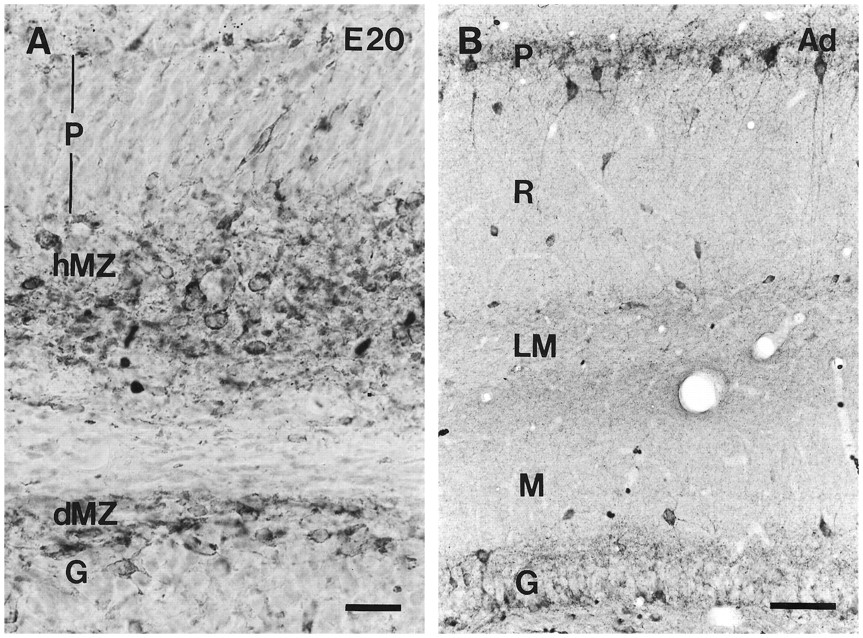
Comparison of the GAD67 cell body labeling patterns in coronal sections of the developing (A) and mature (B) hippocampal formation. For comparison of the laminar patterns, the sections are shown at different magnifications with approximate alignments of the pyramidal and granule cell layers.A, At E20, GAD67-containing cell bodies are highly concentrated throughout much of the marginal zones, the future dendritic regions, of the CA1 field of the hippocampus (hMZ) and dentate gyrus (dMZ) and extend to the borders of the pyramidal (P) and granule (G) cell layers. Relatively few labeled neurons are present within these layers.B, In the CA1 field of the adult (Ad) hippocampus, low densities of GAD67-containing neurons are found within the dendritic regions of strata radiatum (R) and lacunosum/moleculare (LM), whereas higher densities are present in the stratum pyramidale (P) and at the interface between the strata radiatum and lacunosum/moleculare. Likewise, in the dentate gyrus, relatively few labeled neurons are distributed throughout the molecular layer (M), whereas moderate numbers occupy positions within the granule cell layer (G). It is also apparent that as the hippocampal formation matures, the relative proportions of the areas that are occupied by dendritic regions have increased, whereas the proportions occupied by principal cell layers, particularly the pyramidal cell layer, have decreased (compare A and B). Scale bars:A, 25 μm; B, 150 μm.


