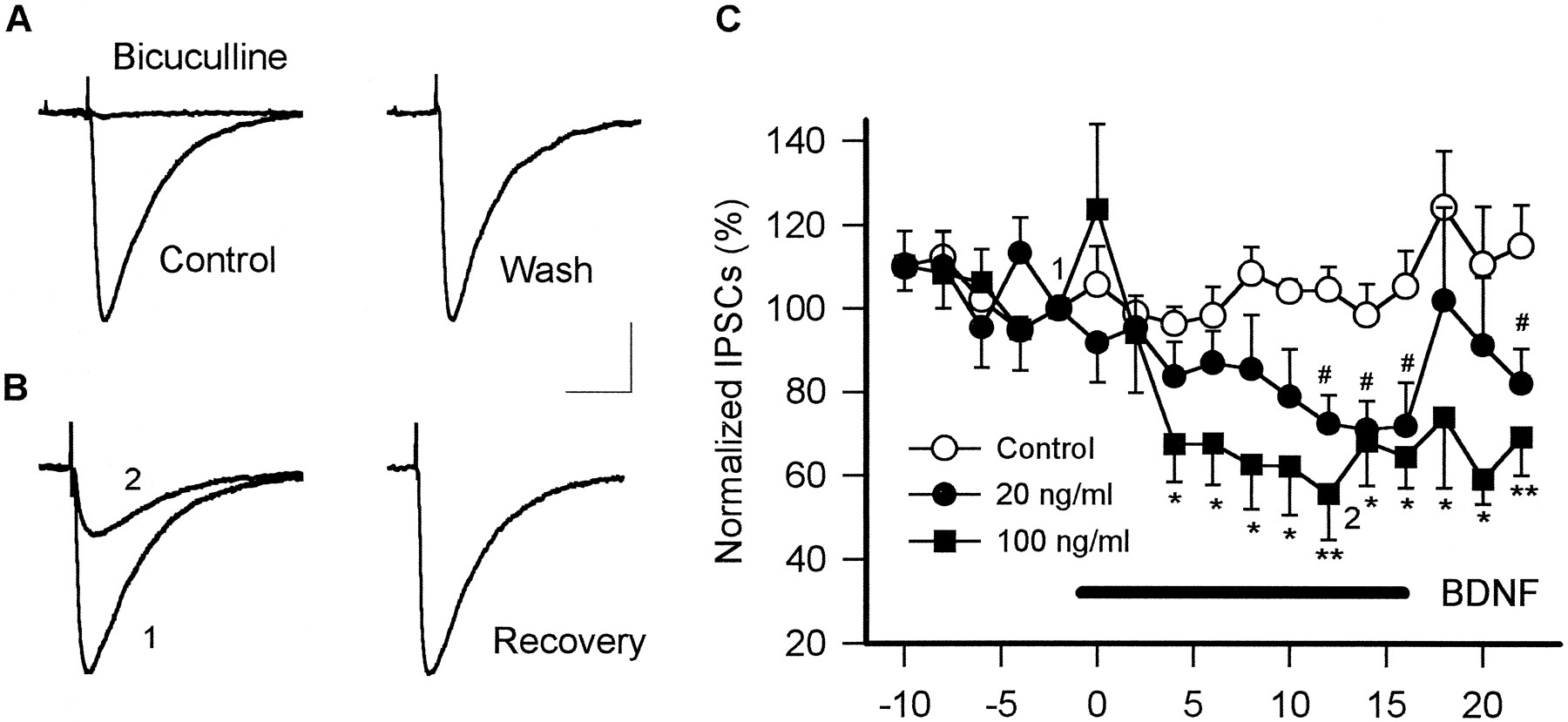
BDNF attenuated GABAA-mediated IPSCs in CA1 pyramidal cells. A, Recording of the bicuculline-sensitive IPSCs from voltage-clamped (−60 mV) CA1 pyramidal neurons in the whole-cell mode. Electrical stimulation of the stratum pyramidal generates the inward currents in the presence of glutamate receptor blockers APV (50 μm) and CNQX (20 μm). The inward currents were blocked completely by a GABAA-receptor antagonist bicuculline (20 μm) (left traces). The right trace is the recovery after a 20 min wash of bicuculline (calibration: 100 pA, 50 msec). B, Effect of BDNF on evoked IPSCs. Bath-applied BDNF (100 ng/ml, 15 min) dramatically reduced the amplitude of IPSCs. Two representative IPSCs (left) are from the time points indicated in C. In this neuron IPSCs recovered almost completely after a 30 min washout of BDNF (right). Each trace represents the averaged IPSCs of eight consecutive sweeps (calibration: 100 pA, 50 msec). C, The time courses of inhibition of the amplitude of IPSCs. Perfusion of BDNF (indicated as ahorizontal solid bar) significantly reduced the amplitude of IPSCs (solid circles, 20 ng/ml;solid squares, 100 ng/ml;#p < 0.05, *p < 0.05, **p < 0.01, Dunnett test;n = 5–7). Data are indicated as mean ± SEM normalized to the amplitudes at the time point just before the application of BDNF.


