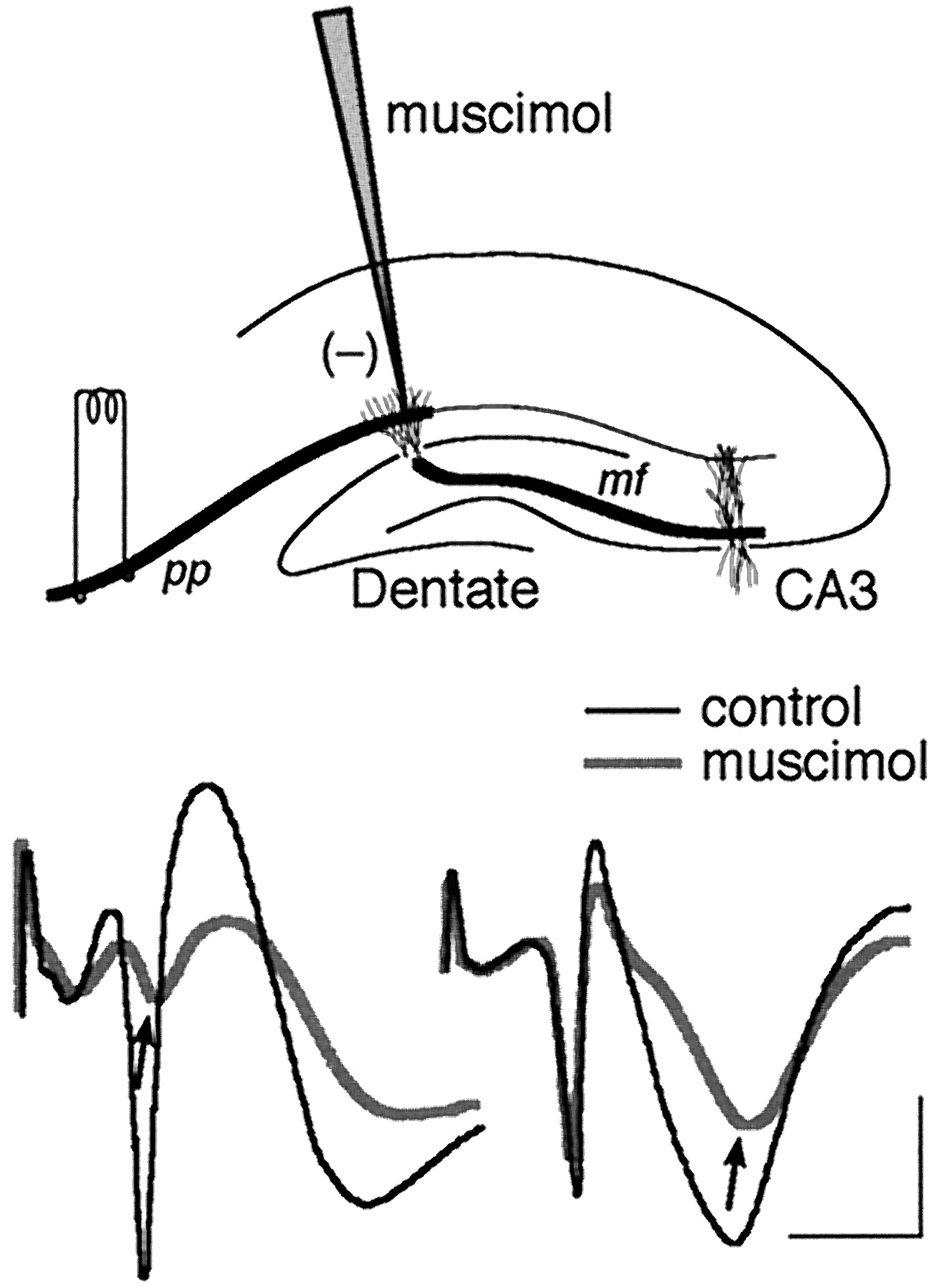
Characterization of disynaptically evoked responses in CA3 by stimulation of entorhinal afferents. The presence of disynaptic input to CA3, via mossy fiber (mf) input, was confirmed by selectively altering granule cell responsiveness to perforant path (pp) stimulation and observing changes in longer-latency components of CA3 field responses. Local application of the GABAA agonist muscimol (100–500 μm) into the dentate gyrus suppressed granule cell responsiveness (arrow) to perforant path stimulation (the same stimulation intensity was used for both control and muscimol conditions) and concomitantly increased suppression of the longer-latency component of the CA3 response (arrow). Waveforms represent averages of five responses. Calibration bar, 5 msec and 1 mV.


