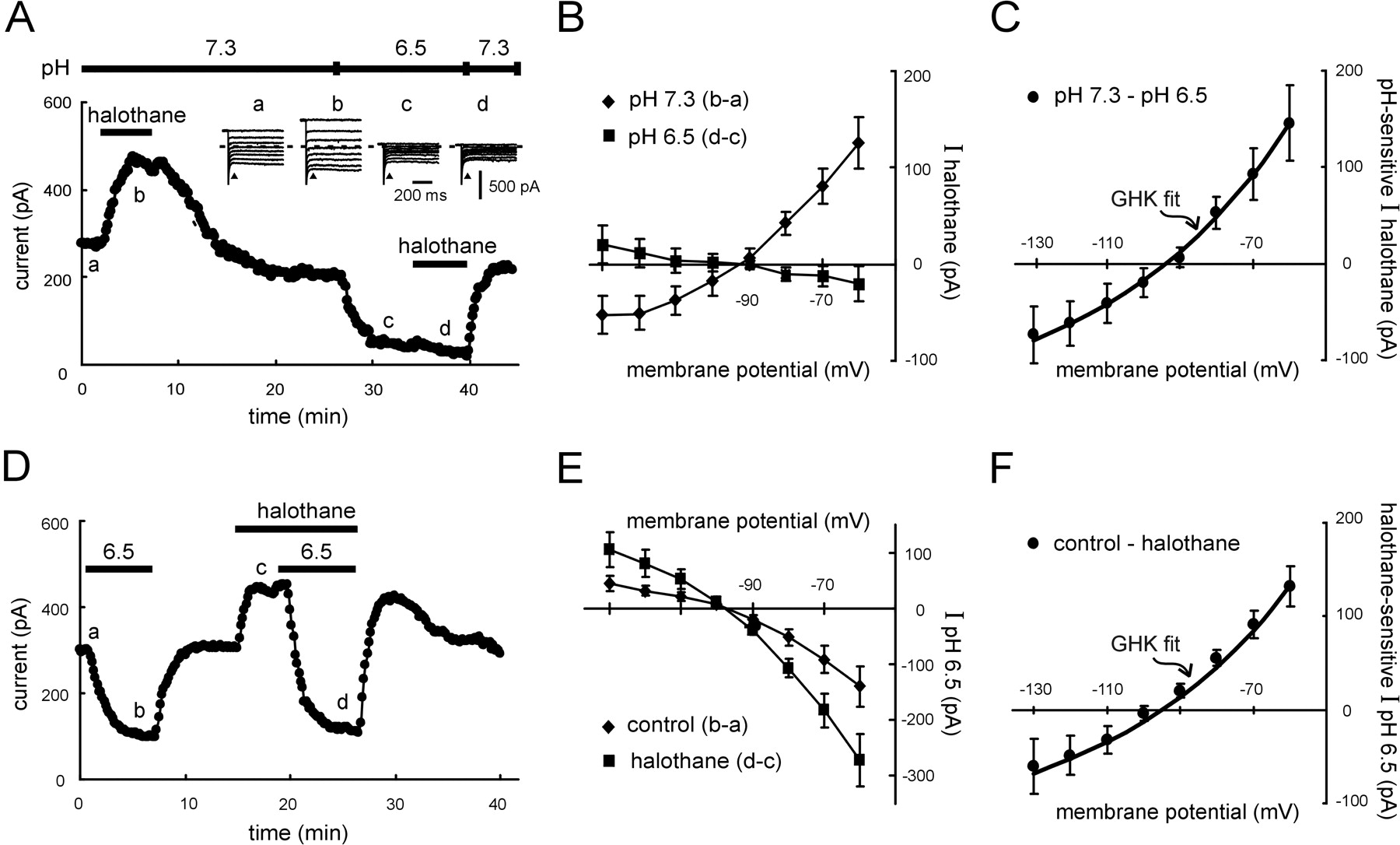
The pH-sensitive halothane-activated K+ current in motoneurons has the properties of an open-rectifier. A, Voltage-clamp recording of membrane current in a hypoglossal motoneuron held at −60 mV. A supramaximal concentration of halothane (1.25 mm) induced an outward current under control conditions that was completely inhibited after blocking the pH-sensitive background K+ current with an acidified extracellular solution. Inset, Sample current responses to voltage steps (−60 to −130 mV) obtained at the indicated time points; I–V relationships were determined from currents measured immediately after the capacitive transient (arrowhead). B, AveragedI–V relationships (± SEM, n = 5) of the halothane-induced current in motoneurons at pH 7.3 (diamonds) and pH 6.5 (squares).C, Averaged data depicting the I–Vrelationship of the pH-sensitive component of halothane-induced current in motoneurons. The data were derived by subtraction of theI–V data obtained in pH 6.5 from that in pH 7.3 (± SEM, n = 5) and were well fitted by using the GHK constant field equation. D, Voltage-clamp recording of membrane current in a hypoglossal motoneuron held at −60 mV. An acidified solution, pH 6.5, induced an inward shift in current that reversed after wash, whereas halothane (1.25 mm) evoked an outward shift. When retested in the continued presence of halothane, the current induced by acidified solution was enhanced by an amount essentially identical to the size of the halothane current itself.E, Averaged I–V relationships (± SEM,n = 12) of the pH-sensitive currents recorded under control conditions (diamonds) and in the presence of halothane (squares). F, Averaged data depicting the I–V relationship of the halothane-induced component of pH-sensitive current. The I–V data were derived by subtraction of currents induced by acidification under control conditions from those in the presence of halothane (± SEM,n = 12) and were well fitted by using the GHK constant field equation.


