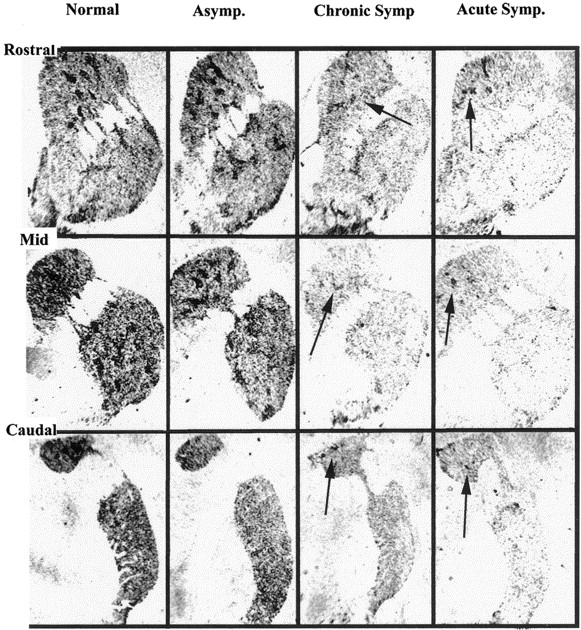
Autoradiograms of coronal brain sections showing PPT mRNA expression in control (Normal), asymptomatic (Asymp.), acutely symptomatic (Acute Symp.), and chronically symptomatic (Chronic Symp.) monkeys. The top row shows the rostral striatum, including the caudate nucleus, putamen, and nucleus accumbens. The middle row shows the mid level of the striatum, including the caudate nucleus, putamen, and external segment of the globus pallidus. The bottom row shows the caudal striatum, including the putamen, body of the caudate nucleus, and both the internal and external segments of the globus pallidus. Note the similarities between the asymptomatic animal and the control, and compare with the acutely and chronically symptomatic animals.Arrows in the caudate nucleus in acutely and chronically symptomatic animals indicate the partial sparing of PPT mRNA expression in the patch compartment, which is not seen in the putamen.


