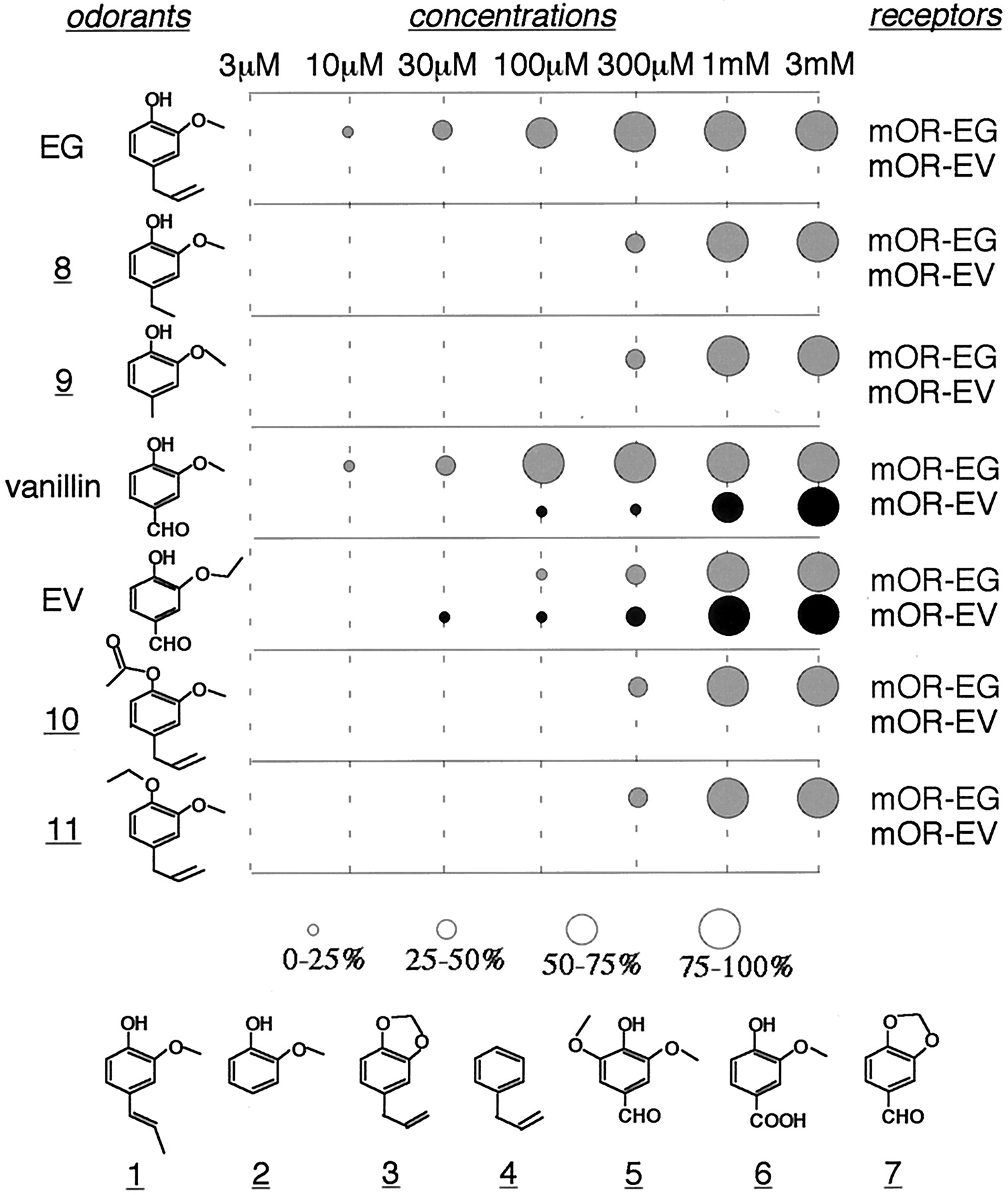
The mOR-EG and mOR-EV recognize overlapping sets of odorants with different affinities and specificities. Dose dependencies of mOR-EG and mOR-EV for various odorant molecules that share some structural similarities with EG or EV were obtained by Ca2+ response assays in HEK293T cells. Thesizes of the circles corresponds to the magnitude of Ca2+ responses normalized as a percentage of the responses at 3 mm ligand: from thesmallest circle for 0–25%, to the biggest circle for 75–100% as indicated. EG and vanillin have the highest affinity for mOR-EG among the odorants tested in this study. The mOR-EG also recognizes odorants 8, 9,10, and 11 at a threshold concentration of 300 μm. The mOR-EV recognizes vanillin and EV with different affinities from those of mOR-EG. Compounds1–7 did not activate mOR-EG or mOR-EV.1, Isoeugenol; 2, guaiacol;3, safrol; 4, allylbenzene;5, syringic aldehyde; 6, vanillic acid;7, heliotropyne; 8, 2-methoxy-4-ethylphenol; 9, 2-methoxy-4-methylphenol;10, eugenol acetate; 11, eugenol ethyl ether.


