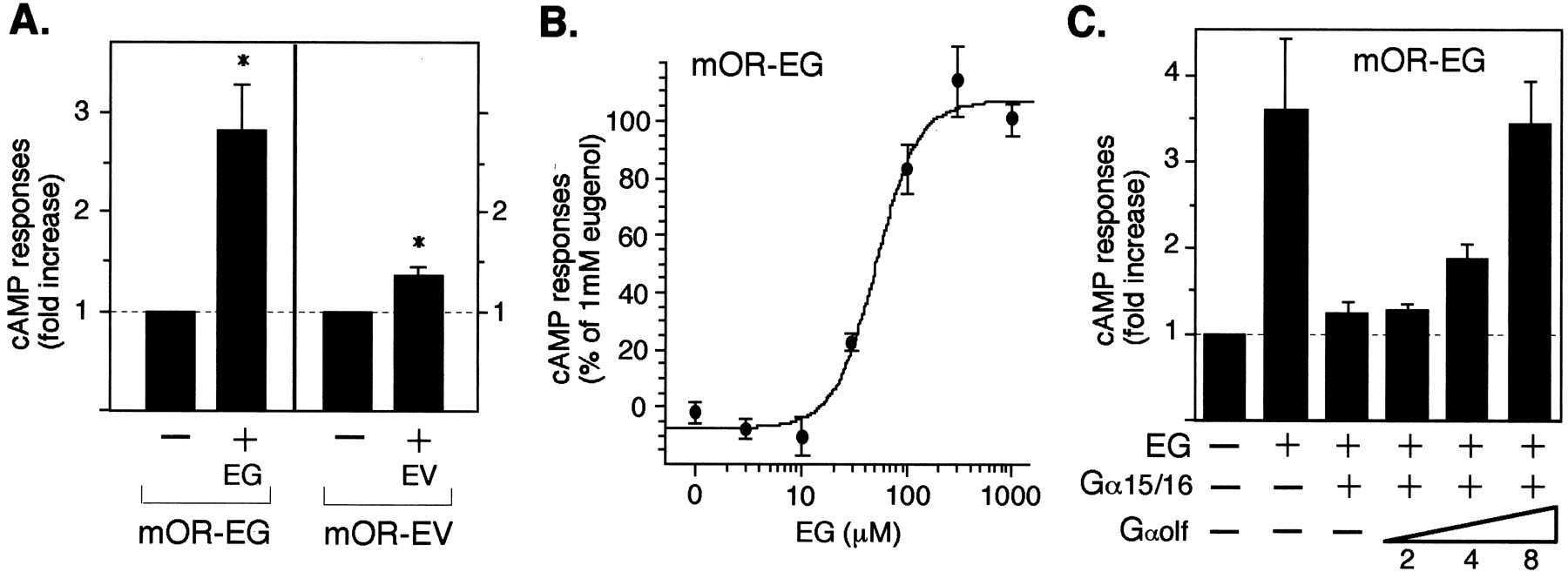
Odorant receptors couple to stimulatory G-proteins Gαs or Gαolf and induce cAMP increases in HEK293T cells.A, EG (300 μm) induced a 2.75-fold cAMP increase in HEK293T cells transfected with mOR-EG. EV (1 mm) induced a 1.3-fold cAMP increase in HEK293T cells transfected with mOR-EV. The data are mean ± SE of five and seven independent transfection experiments for mOR-EG and mOR-EV, respectively (*p < 0.05). B, Dose-dependent cAMP elevation as a percentage of the response to 1 mm EG by mOR-EG-transfected HEK293T cells. Thepoints represent the mean ± SE of three experiments. C, Gαolf coupling to the mOR-EG. The cAMP increase by EG (300 μm) in mOR-EG-transfected HEK293T cells was completely inhibited by cotransfection of Gα15/16. As the ratio of Gαolf to Gα15/16 was increased by cotransfection of Gαolf (2–8 times equivalent of the plasmid amount), the cAMP responses were rescued. Data are representative of three independent transfection experiments.


