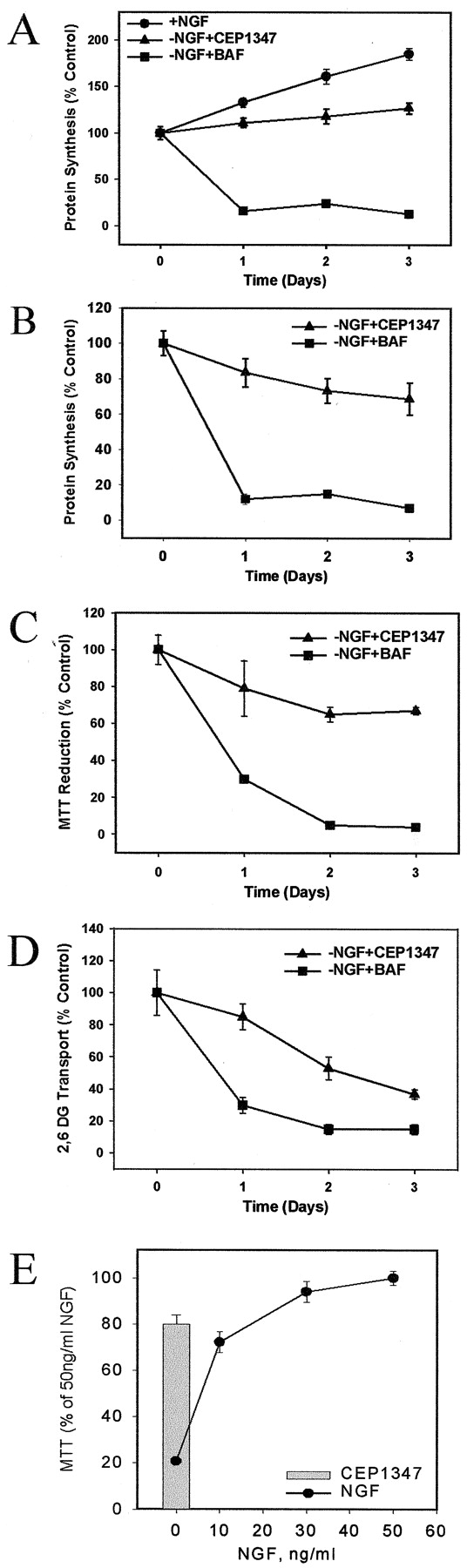
CEP-1347 maintains the metabolism of NGF-deprived neurons. A, Neurons were maintained in NGF for 5 d, at which time they were switched to serum-free media containing NGF (50 ng/ml), BAF (50 μm), or CEP-1347 (500 nm) for the specified times. At each time point the protein synthesis rates were measured as described in Materials and Methods, and the value of 5 DIV NGF-maintained cultures was taken as 100%. The absolute protein synthesis rates of CEP-1347-treated cultures actually increase over time, albeit to a lesser extent than NGF-maintained cultures. B, Data plotted relative to NGF-maintained cultures of the same age.C, Neurons were treated identically as inB but assayed for mitochondrial activity by measuring MTT reduction as described in Materials and Methods. D, Neurons were treated as in B, except that the cultures were assayed for 2,6-deoxyglucose transport as described in Materials and Methods. E, CEP-1347 treatment is equivalent to ∼15 ng/ml NGF. Neurons were grown in 50 ng/ml for 5 d and then switched to various amounts of NGF for 36 hr (filled circles). MTT reduction was measured. Vertical bar, CEP-1347 treatment with no NGF. A–D,p < 0.05 for −NGF + BAF versus −NGF + CEP-1347 for all time points.


