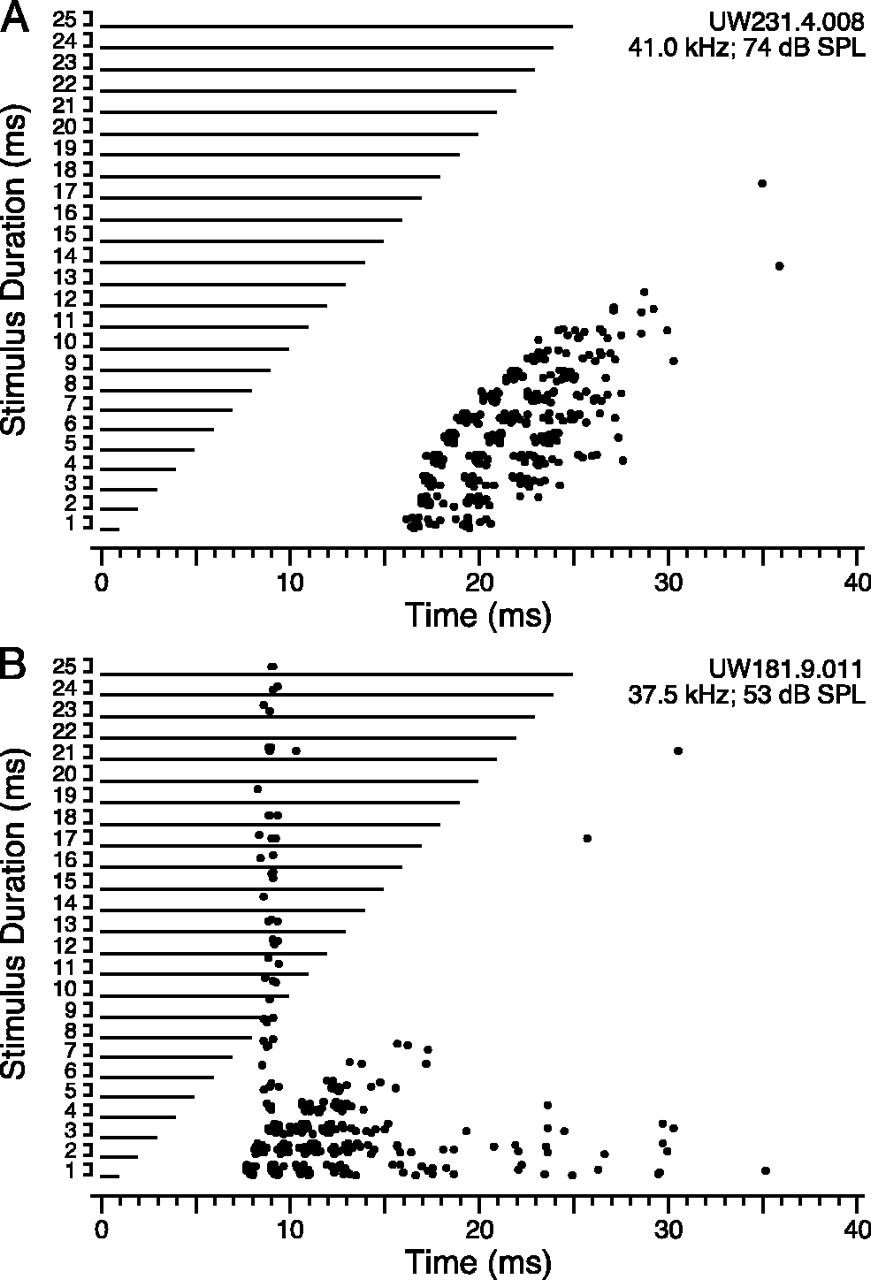
Temporal response patterns of two duration-tuned neurons. A, Poststimulus rastergram illustrating the offset response of a bandpass neuron with a BD of 4 msec. At and above BD, the first spike latency increased as the duration of the tone pulse was lengthened, tracking the offset of the stimulus. B, Poststimulus rastergram showing the offset response plus onset breakthrough pattern of a short-pass neuron with a BD of 1 msec. For 1–6 msec tones, the first spike latency tracked the offset of the stimulus; however, for 4–25 msec tones, the cell occasionally responded with spikes time-locked to the onset of the stimulus. The latencies of the onset breakthrough spikes were longer than the latencies of the spikes in response to tones of 1–3 msec, suggesting that inhibition precedes excitation. All stimuli were BEF tone pulses of variable duration presented at 30 dB above BD threshold; 15 trials per stimulus.


