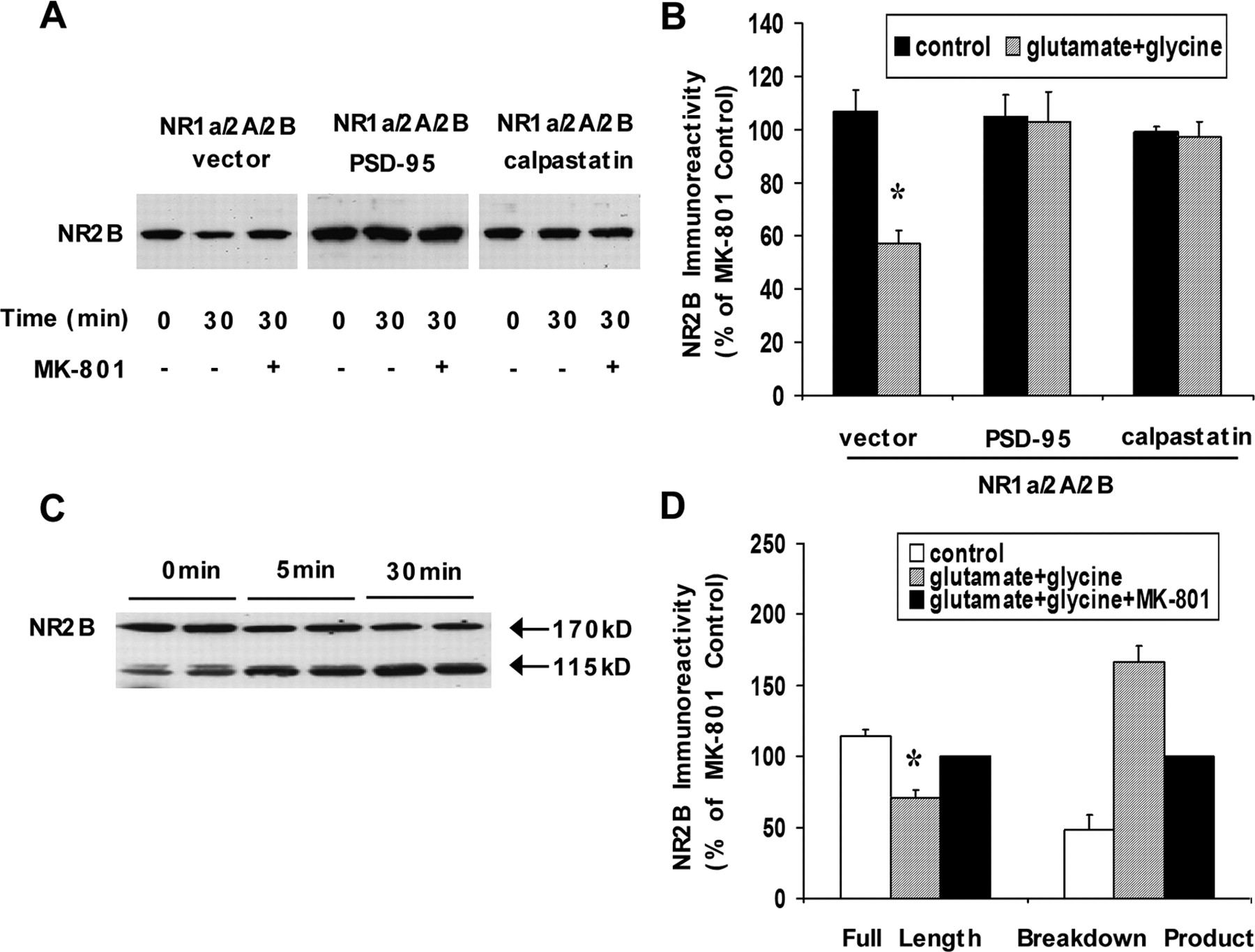
Effects of PSD-95 on calpain-mediated cleavage of the NR2B subunit. A, Representative Western blots of NR2B from HEK293 cells cotransfected with NR1a, NR2A, NR2B, and PSD-95, calpastatin, or vector control and treated with 100 μm glutamate and 100 μm glycine in the presence or absence of 100 μm MK-801 for 0 or 30 min. B, Quantification of NR2B levels. Agonist treatment resulted in the significant degradation of NR2B (N-terminal antibody to NR2B; *p = 0.0157; n = 5). Coexpression of PSD-95 or calpastatin inhibited the reduction in NR2B immunoreactivity. No stable breakdown product of NR2B was observed subsequent to calpain activation. C, Representative Western blots of NR2B from cultured cortical neurons treated with 100 μm glutamate and 100 μm glycine for 5 or 30 min. D, Quantification of NR2B levels. Agonist treatment decreased the level of full-length NR2B and increased the level of an N-terminal breakdown product (115 kDa) compared with 0 min (N-terminal antibody to NR2B; n = 6; p = 0.0049 for full-length NR2B; 0 vs 30 min; p = 0.0057 for NR2B breakdown product; 0 vs 30 min). The inclusion of MK-801 prevented the loss of full-length NR2B and the increase in the NR2B breakdown product. NR2B immunoreactivity was quantitated as a percentage of the MK-801 control condition. Data are shown as mean ± SEM (error bars).


