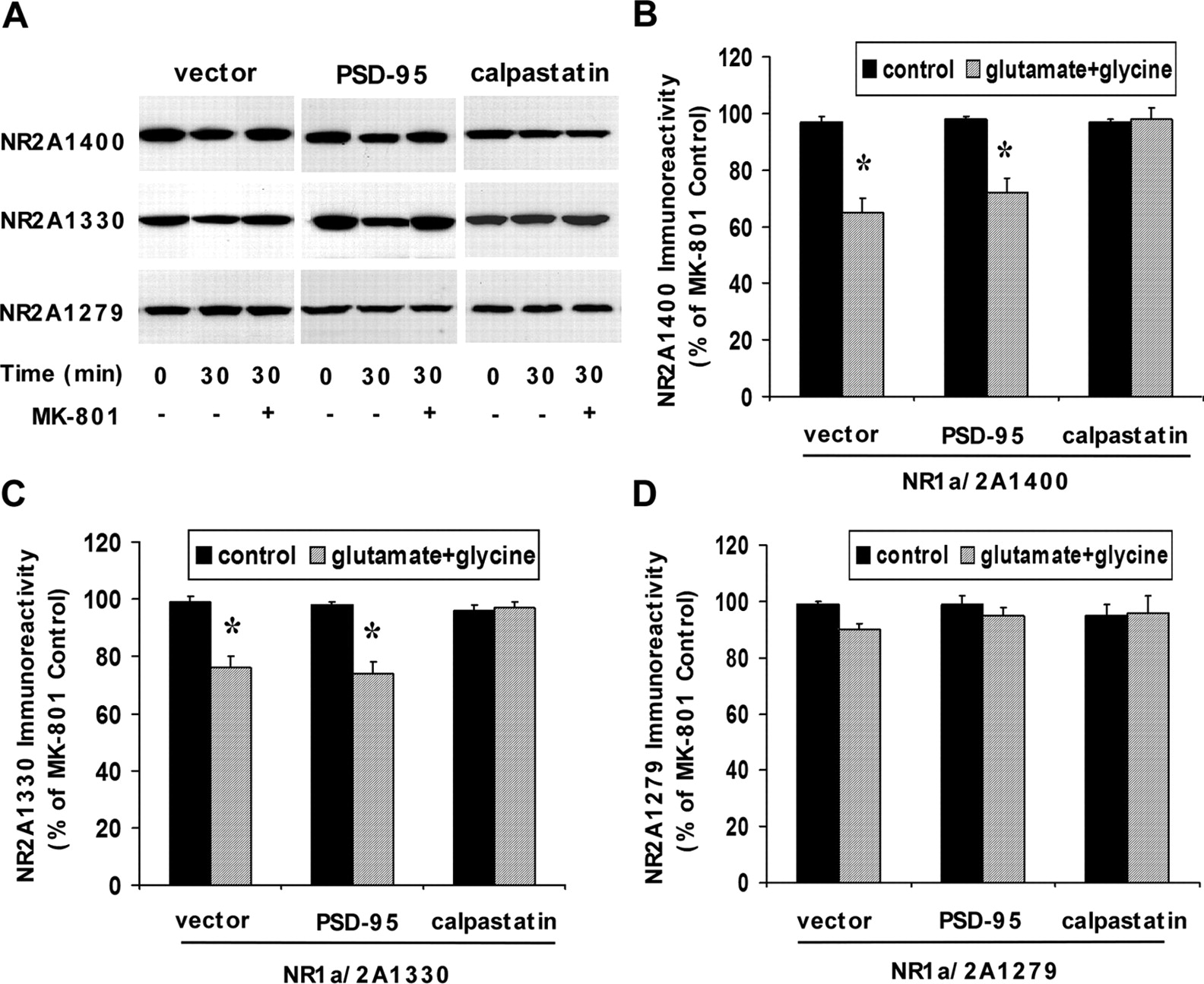
Effects of PSD-95 on the cleavage of shortened forms of NR2A by calpain. A, Representative Western blots of NR2A1400, NR2A1330, and NR2A1279 from HEK293 cells cotransfected with NR1a and PSD-95, calpastatin, or vector control and treated with 100 μm glutamate and 100 μm glycine in the presence or absence of 100 μm MK-801 for 0 or 30 min. B, Quantification of NR2A1400 levels. Agonist treatment of cells cotransfected with NR1a/NR2A1400 resulted in the significant degradation of NR2A1400 (N-terminal antibody A-6475; *p = 0.0001; n = 6). Coexpression of calpastatin inhibited the reduction in NR2A1400 immunoreactivity, but the presence of PSD-95 had no effect (*p = 0.0023; n = 4). C, Quantification of NR2A1330 levels. Agonist treatment of cells cotransfected with NR1a/NR2A1330 resulted in the significant degradation of NR2A1330 (N-terminal antibody A-6475; *p = 0.0037; n = 8). Coexpression of calpastatin inhibited the reduction in NR2A1330 immunoreactivity, but the presence of PSD-95 had no effect (*p = 0.0149; n = 7). D, Quantification of NR2A1279 levels. No detectable change in NR2A1279 immunoreactivity was observed after agonist treatment (p = 0.1767; n = 5). No difference was seen after coexpression of calpastatin or PSD-95. Quantitated data are expressed as a percentage of the MK-801 control condition. Data are shown as mean ± SEM (error bars).


