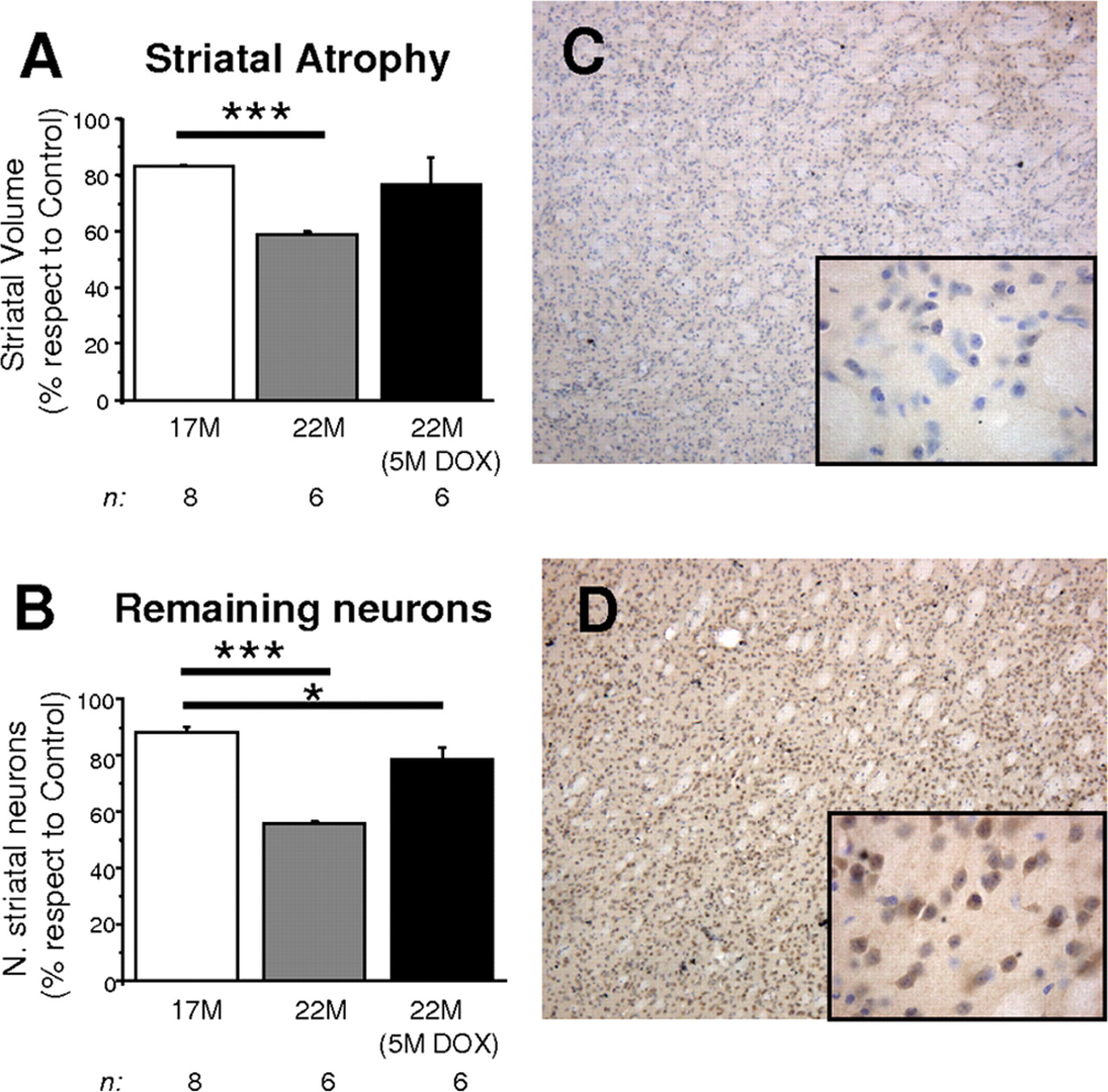
Silencing mutant-htt expression in Tet/HD94 mice halts additional loss of striatal neurons and boosts DARPP-32 expression in the remaining ones. A, B, Stereological measurement of striatal volume on DARPP-32 immunostained sections (A) or number of striatal neurons on Neu-N-immunostained sections (B). Results are presented as the evolution of percentage of Tet/HD94 values with respect to their control littermates from the age of 17 months (open bar) to the age of 22 months either with continued expression (gene-on; gray bar) or doxycycline-treated (gene-off; black bar). Significant differences between groups were determined by ANOVA: ***p < 0.001; *p < 0.02. Striatal volume values for control mice were as follows: 12.1 ± 0.56 mm3 for 17-month-old, 9.8 ± 0.8 mm3 for untreated 22-month-old, and 10.1 ± 0.6 mm3 for doxycycline-treated 22-month-old mice. Numbers of striatal neurons in control mice were as follows: 1.49 × 10⁶ ± 0.04 neurons in 17-month-old ones, 0.99 × 10⁶ ± 0.01 neurons in untreated 22-month-old ones, and 1.11 × 10⁶ ± 0.02 in doxycycline-treated 22-month-old ones. C, D, Striatal sections from 22-month-old gene-on (C) or gene-off (D) Tet/HD94 mice were immunostained with an antibody against DARPP-32 (brown labeling) and counterstained with Nissl dye (blue labeling). A dramatic increase in the number and intensity of positive DARPP-32 striatal neurons was observed in gene-off compared with gene-on mice. Insets in C and D show a 5× magnification. N., Number; M, month; DOX, doxycycline.


