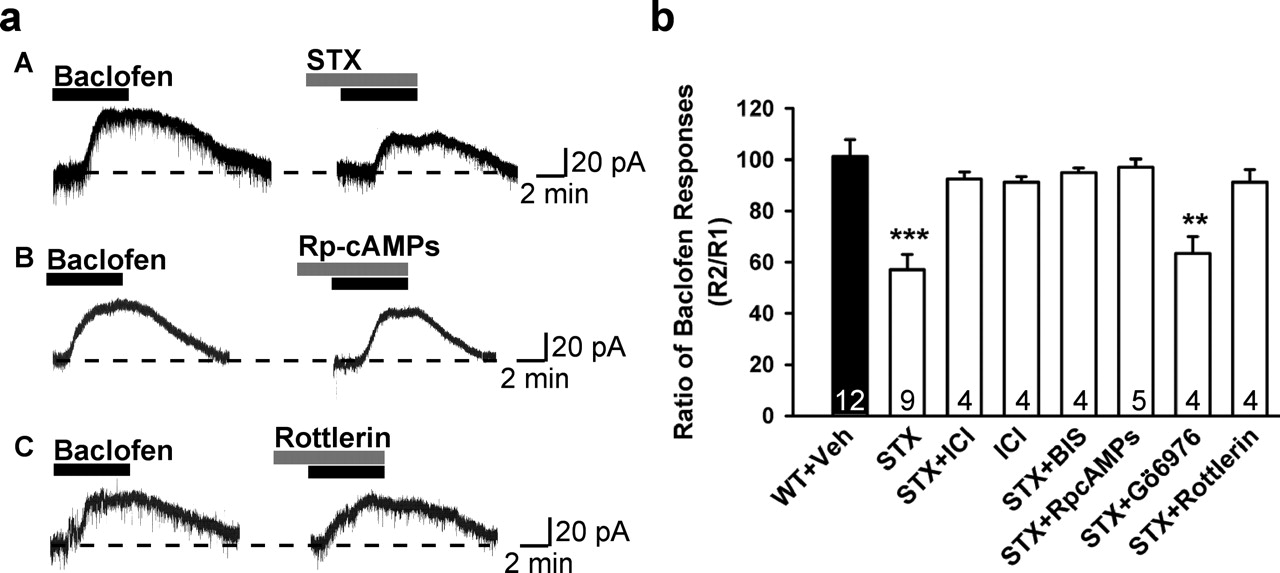
STX attenuation of the GABAB response depends on activation of PKC and PKA activation in hypothalamic arcuate (POMC) neurons. a, Three representative traces of the baclofen response in the presence of STX (100 nm), STX and Rp-cAMPs (200 μm), or STX and rottlerin (5 μm) in arcuate neurons from ovariectomized guinea pigs are shown. b, Bar graphs summarizing the effects of inhibitors of the effects of STX. Veh, Vehicle. Experiments were conducted as described in Materials and Methods. Cells were dialyzed for 15 min before baclofen application with BIS (100 nm) or Rp-cAMPs (200 μm), which were included in the patch-pipette solution. STX (100 nm) rapidly attenuated the outward (GIRK) current induced by the GABAB receptor agonist baclofen in arcuate (POMC) neurons, which was reversed by the estrogen receptor antagonist ICI 182,780 (1 μm). ICI alone had no effect. BIS (an inhibitor of all PKC isoforms), the selective PKCδ inhibitor rottlerin (5 μm), and the PKA inhibitor Rp-cAMPs could reverse, but the selective inhibitor of conventional PKC isoforms, Gö6976 (2 μm), could not block the attenuation of the baclofen response by STX in arcuate neurons including POMC neurons. BIS (n = 7), RpcAMPs (n = 4), and rottlerin (n = 3) alone had no effect on the baclofen response (data not shown). Bars represent the mean ± SEM. Thirty-nine percent of the neurons were β-endorphin (POMC) neurons (n = 54). **p < 0.01 and ***p < 0.001 versus vehicle control.


