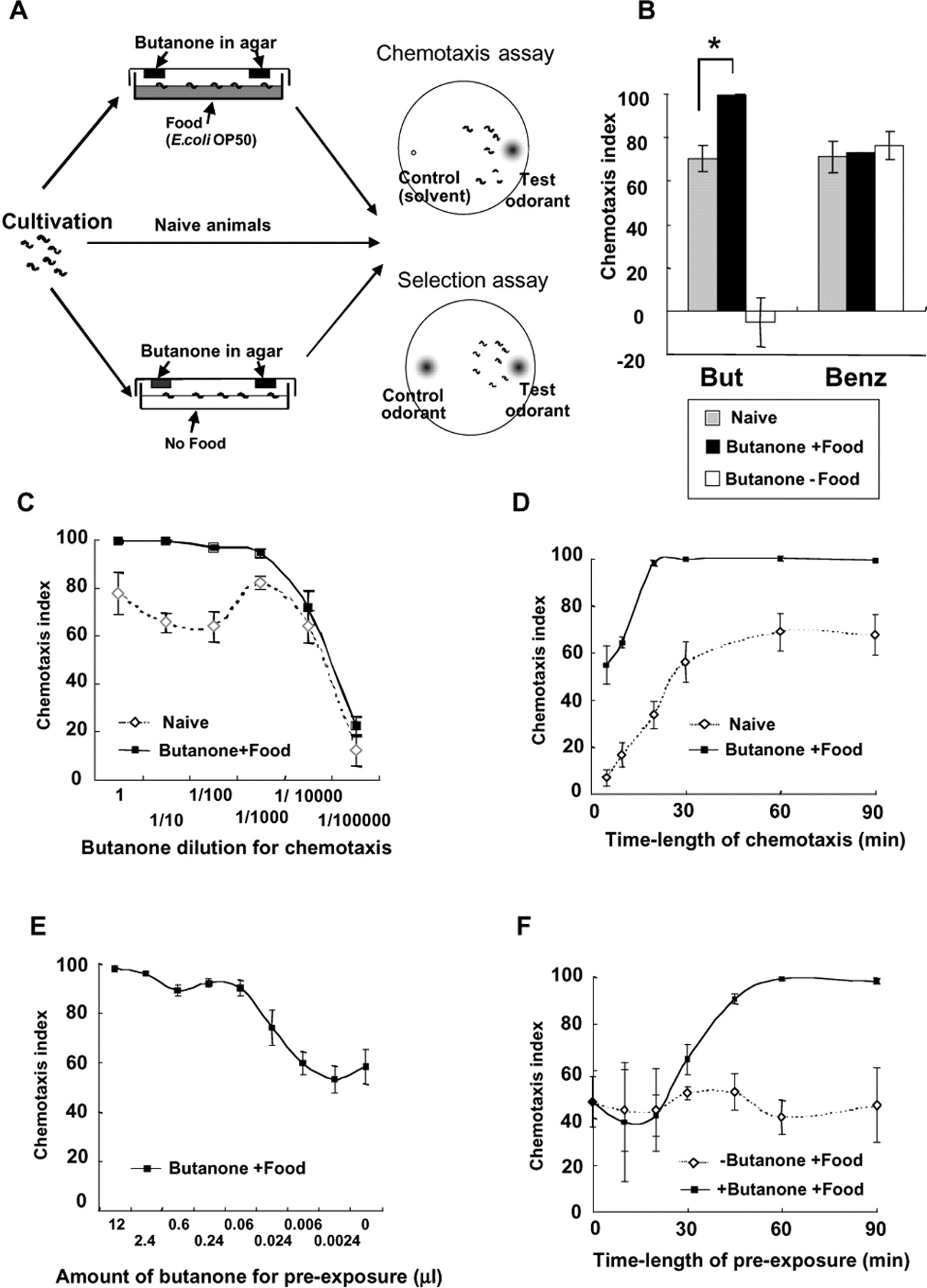
Characteristics of butanone enhancement. A, The assay method of butanone enhancement. Animals preexposed to butanone in the presence (top) and absence (bottom) of food for 90 min and naive animals (middle) were tested for chemotaxis to the test odorant (top) or for selection between the test odorant and the control odorant (bottom) for 60 min. B, Preexposure to butanone and food enhanced chemotaxis of wild-type animals to butanone but not to benzaldehyde. Chemotaxis indexes to 2 μl of 1:10 butanone (But) and 2 μl of 1:35 benzaldehyde (Benz) without and after preexposure to 12 μl of butanone in the presence and absence of food. Animals kept in the absence of butanone and food showed the same chemotaxis indexes as naive animals, although the data are not shown. Fifteen plates were used for each data of butanone chemotaxis and eight plates for each data of benzaldehyde chemotaxis. *p < 0.005, comparing naive animals and animals preexposed to butanone and food for butanone chemotaxis. Chemotaxis to benzaldehyde was conducted at various dilutions, but enhancement of chemotaxis by preexposure to butanone and food was not detected at all. C, Dose–response curves of wild-type animals for chemotaxis to butanone after and without preexposure to butanone and food. The abscissa shows the dilution of butanone used for chemotaxis. At least six plates were used for all data. D, Dependence of chemotaxis indexes on the time length of chemotaxis to butanone after and without preexposure to butanone and food. Six plates were used for all data. E, Dependence of chemotaxis indexes on the amount of butanone for preexposure in butanone enhancement. Butanone was diluted 2- to 10,000-fold with ethanol for preexposure. The abscissa shows the amount of butanone contained in the solution for preexposure. Four to six plates were used for all data. F, Dependence of chemotaxis indexes on the time length of preexposure to butanone and food and to food without butanone (control). Six plates were used for all data. In all of these figures, the butanone dilution and the time length for chemotaxis were 1:10× and 60 min, whereas the amount of butanone and the time length for preexposure were 12 μl and 90 min, respectively, unless otherwise indicated. The error bars indicate SEM.


