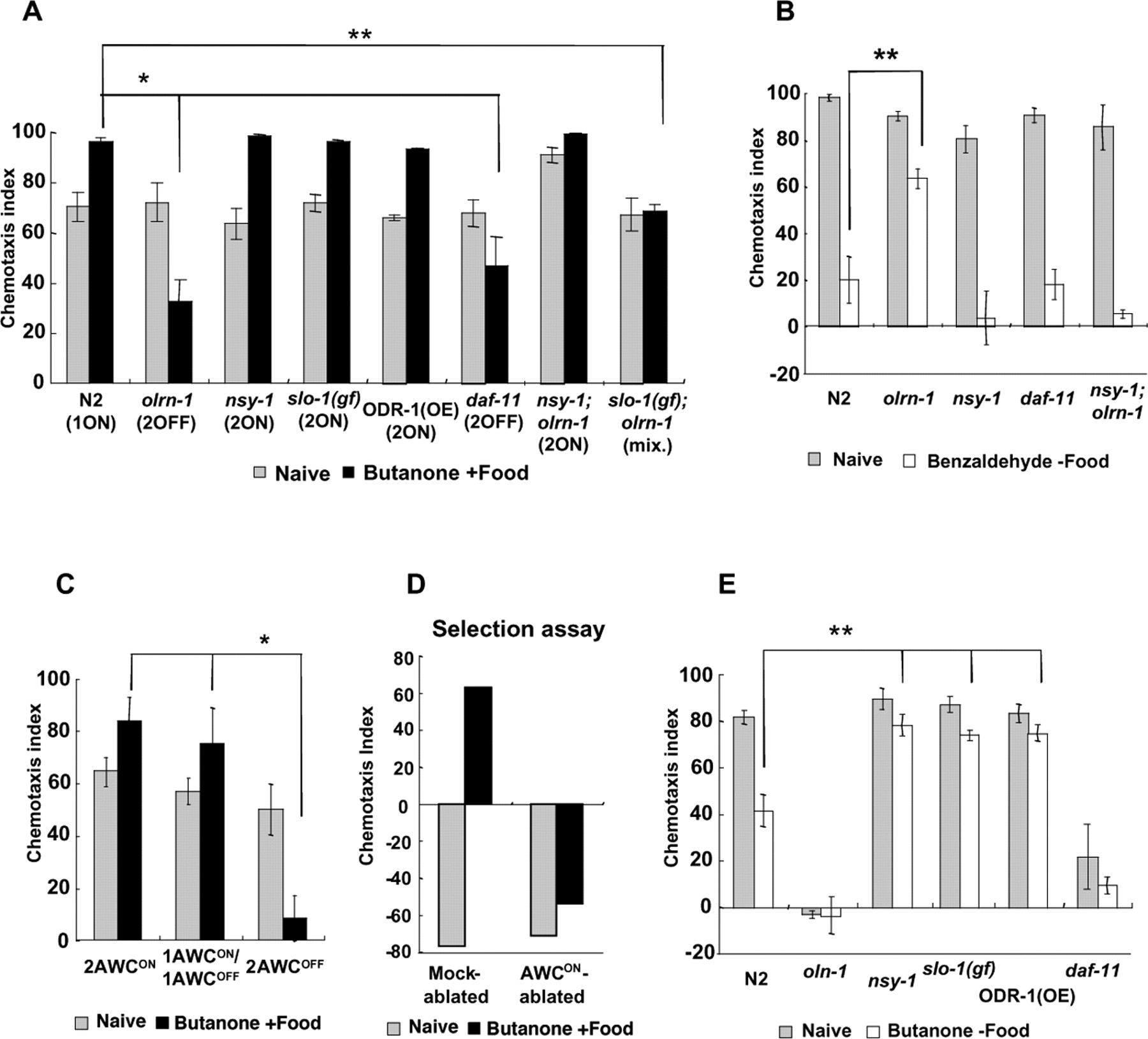
Effect of AWC symmetry mutations on butanone enhancement, adaptation to benzaldehyde, and adaptation to butanone. A, Effect of AWC symmetry mutations on butanone enhancement. The AWC symmetry phenotypes are shown below the genotype: “1ON,” “2OFF,” and “2ON” indicate 1 AWCON/1 AWCOFF(the wild-type phenotype), 2 AWCOFF, and 2 AWCON phenotypes, respectively, whereas the double-mutant slo-1(gf);olrn-1 produces animals of all the three phenotypes. ODR-1(OE) is an odr-1(n1936) mutant strain carrying high-copy transgenes of the wild-type odr-1 genomic clone. Four to 15 plates were used for all data. *p < 0.005, **p < 0.05, comparing the wild-type (N2) animal with the olrn-1, daf-11, and slo-1(gf);olrn-1 mutants, respectively, for butanone enhancement. The dilution of butanone for chemotaxis was 1:10 (standard assay). B, Adaptation to benzaldehyde of olrn-1, nsy-1, daf-11, and nsy-1;olrn-1 mutants. Chemotaxis to 1:200 benzaldehyde was conducted without and after exposure to 1.8 μl of benzaldehyde in the absence of food. Five to 15 plates were used for all data. **p < 0.05, comparing the wild-type (N2) animal with the olrn-1 mutant for adaptation. C, The results of butanone enhancement assay (chemotaxis assay) for 2 AWCON, 1 AWCON/1 AWCOFF, and 2 AWCOFF animals, respectively, all having the genotype of slo-1(gf);olrn-1. *p < 0.005, comparing 2 AWCOFF animals with 2 AWCON and 1 AWCON/1 AWCOFF animals, respectively, for butanone enhancement. Three plates were used for all data. D, The results of butanone enhancement assay (selection assay between 1:10 butanone and 1:100 isoamyl alcohol) for mock-ablated and AWCON-ablated wild-type animals. The selection assay was used to detect the butanone enhancement phenotype with a small number of animals (65–149 animals for each experiment). Each datum represents the result of selection assay using two to four plates. E, Adaptation to butanone of olrn-1, nsy-1, slo-1(gf), ODR-1(OE), and daf-11 mutants. Chemotaxis to 1:1000 butanone for 60 min was conducted without and after exposure to 30 μl of butanone in the absence of food for 90 min. Four to six plates were used for all data. **p < 0.05, comparing the wild-type (N2) animal with the nsy-1 mutant, slo-1(gf) mutant, and ODR-1(OE), respectively, for adaptation. This figure also shows defective chemotaxis of olrn-1 and daf-11 mutants to 1:1000 butanone. The error bars indicate SEM.


