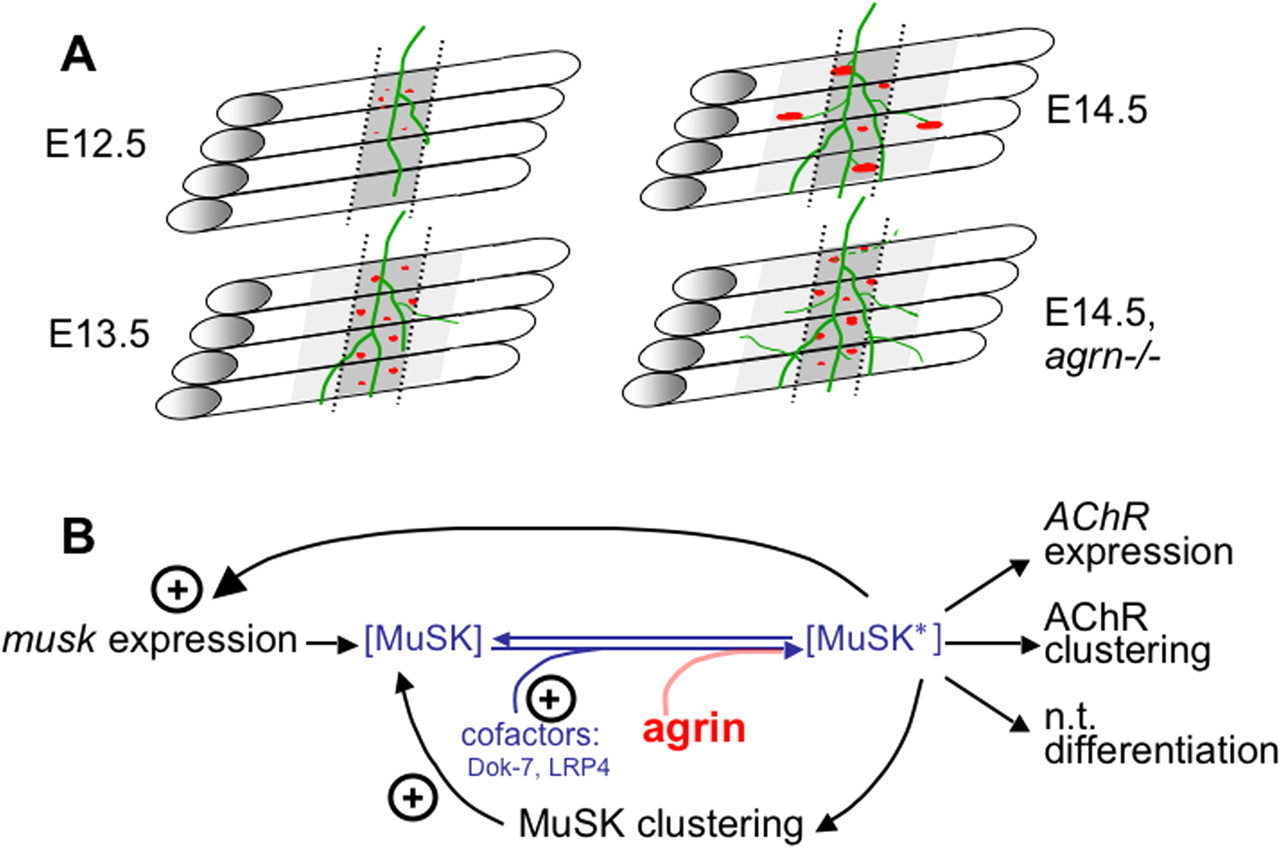
A, Steps of NMJ formation in diaphragms between E12.5 and E14.5 and effects of agrn ablation (bottom right). Dark gray area marked by dotted lines denotes the region in which aneural AChR clusters form. Adjacent light gray region is responsive to agrin but does not form aneural AChR clusters, perhaps attributable to lower expression levels of MuSK and/or its accessory proteins, e.g., Dok-7 or LRP4. B, Model for early stages of neuromuscular synapse formation. The formation of AChR clusters depends on the local concentration of activated MuSK (MuSK*). In muscle regions in which MuSK is low, agrin from nerves is needed for MuSK activation, resulting in synapse formation consistent with the neurocentric model. Conversely, in regions expressing high levels of MuSK (and of cofactors such as Dok-7 and LRP4), MuSK is autoactivated (MuSK*) and forms numerous aneural AChR clusters. This results in a high probability of motor neurons encountering a preformed AChR cluster, thus favoring innervation of preformed aneural AChR clusters according to the myocentric model. Also shown are feedback loops by which MuSK* stimulates its own aggregation and expression (Jones et al., 1999; Moore et al., 2001).


