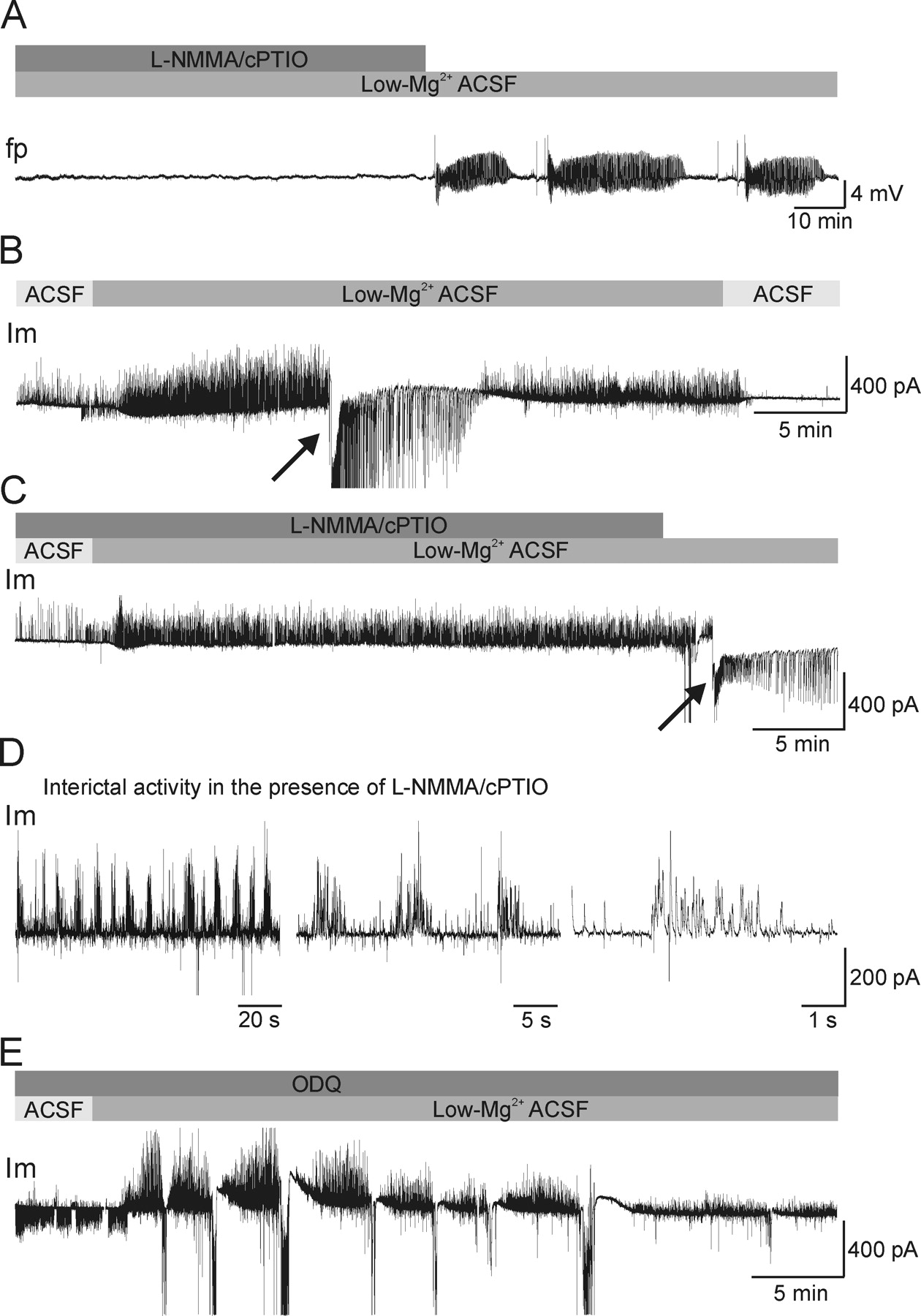
Effects of NO deprivation and sGC inhibition on the epileptiform activity in rat slice cultures. A, Deprivation of NO by coapplication of the NOS inhibitor l-NMMA (200 μm) and the NO scavenger cPTIO (300 μm) prevented development of SLEs. The effect was reversed on washout of l-NMMA/cPTIO. B, Spontaneous postsynaptic currents recorded in a CA3 pyramidal cell under control and low-Mg2+ conditions. The cell was clamped to −50 mV, and inward and outward currents represent EPSCs and IPSCs, respectively. Removal of Mg2+ resulted in an increase in EPSC amplitude as well as in IPSC frequency and amplitude. After a delay of ∼10 min, the first SLE occurred (arrow). C, Spontaneous synaptic activity recorded in an NO-deprived CA3 pyramidal cell under control and low-Mg2+ condition. NO deprivation prevented the initiation of SLEs, although interictal activity was still present. This effect was reversible after removal of l-NMMA/cPTIO, and the first SLE was initiated within a few minutes (arrow). D, Interictal activity as recorded in a CA3 pyramidal cell in an NO-deprived slice culture. Interictal activity consisted of small packages of inhibitory and excitatory synaptic currents, which occurred at a frequency of 0.1–0.5 Hz. From the left to the right, interictal events are presented at shorter timescales. E, Spontaneous synaptic activity recorded in an ODQ-treated CA3 pyramidal cell under control and low-Mg2+ condition. Inhibition of sGC with 10 μm ODQ did not prevent development of SLEs. fp, Field potential; lm, membrane current.


