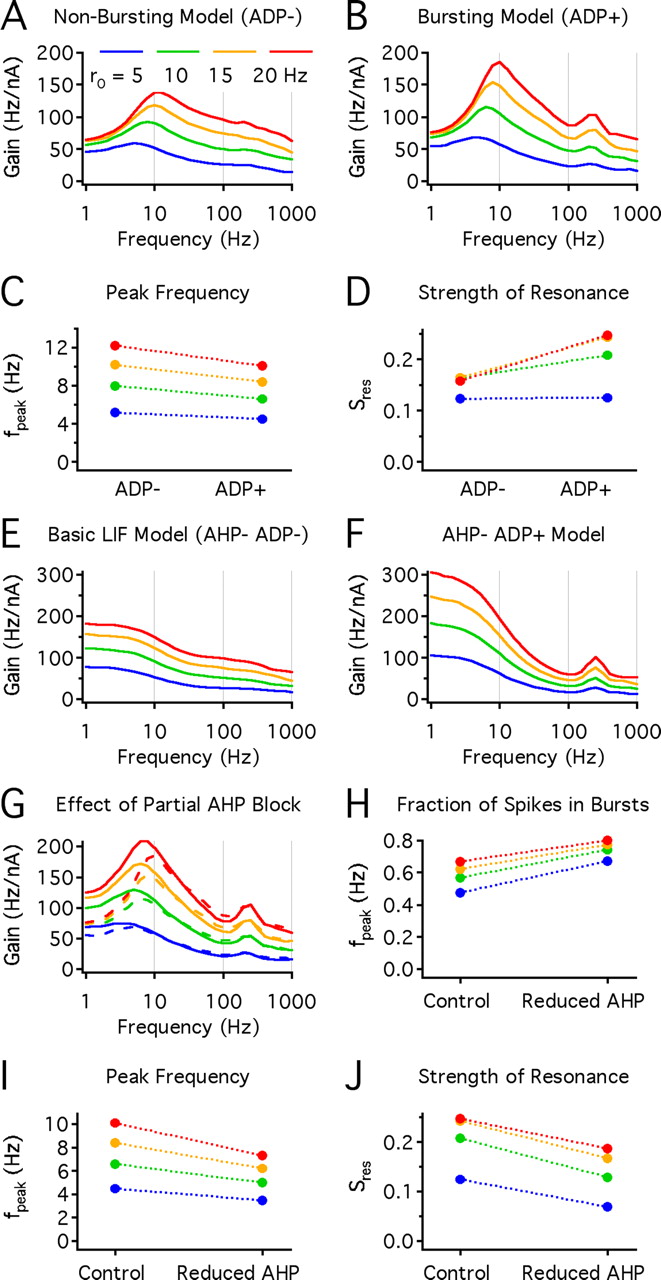
Bursting amplifies firing resonance in a minimal model. Simulations were performed with 5 ms exponential-filtered noise (σI = 0.25 nA). A, G(f) for the nonbursting (ADP−) model. Here and in subsequent panels, levels of IDC were chosen to give r0 = 5, 10, 15, and 20 Hz (blue, green, orange, and red, respectively). B, G(f) for the bursting (ADP+) model, showing higher gain at the primary peak and a small high-frequency resonance at ∼250 Hz. C, At each r0, the primary resonant frequency (fpeak) was slightly lower in the bursting model. D, The strength of the primary resonance (Sres) was higher in the bursting model for r0 = 10, 15, and 20 Hz. E, G(f) for basic LIF model (AHP− ADP−), showing low-pass behavior. F, In the absence of an AHP current, adding the ADP current increased gain at low f and created a small high-frequency resonance. G, Effect of reducing the AHP current by half. Control responses (dashed lines) are from the bursting model illustrated in B. H, Reducing the AHP increased the fraction of spikes in bursts. I, Reducing the AHP lowered the primary resonant frequency at each r0. J, Reducing the AHP decreased the strength of the primary resonance at each r0.


