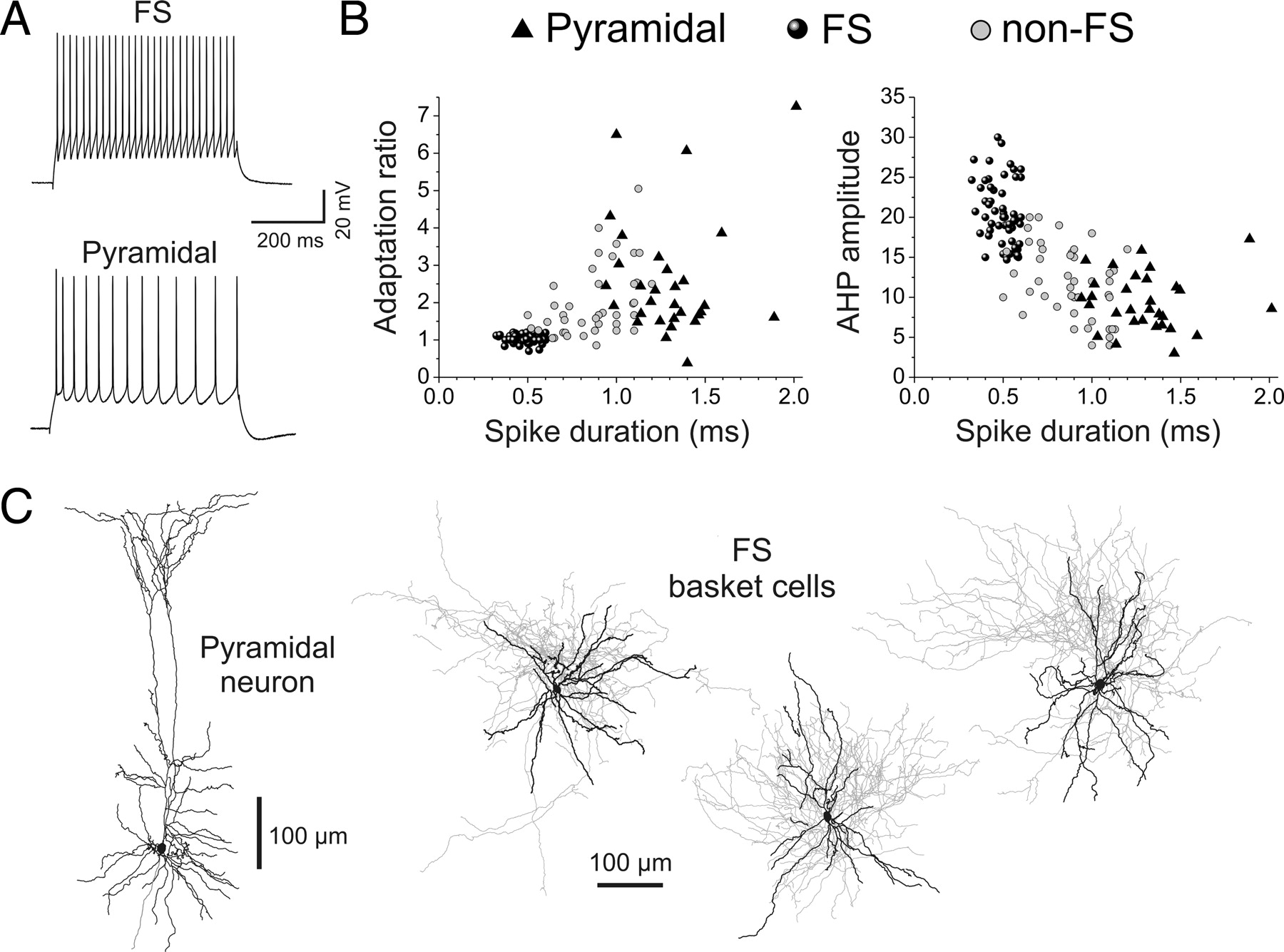
PFC pyramidal cells and FS interneurons were identified based on their firing pattern and morphological properties. A, Top, Firing properties of a typical FS interneuron identified in layer 5. Bottom, Firing properties of a typical layer 5 pyramidal neuron. Some pyramidal cells had weakly bursting properties (not shown). B, Left, Adaptation ratio (last interspike interval/first interspike interval, see Materials and Methods) plotted as a function of spike duration at half peak amplitude for 30 pyramidal cells (triangles), 60 FS neurons (black circles), and 45 non-FS cells (gray circles). Right, Plot of the AHP amplitude versus spike duration at half-width. Cells classified as FS (see Materials and Methods) had spike duration ≤0.6 ms, AHP amplitude ≥15 mV, and adaptation ratio ≤1.2. For examples of non-FS cell properties, see supplemental Figure 1 (available at www.jneurosci.org as supplemental material). C, Examples of the morphological properties of pyramidal cells (left) and FS neurons (right) filled with biocytin during recording. All the FS cells had properties consistent with the basket cell morphological class (no chandelier neurons were found in this data sample). Axons shown in gray, dendrites in black.


