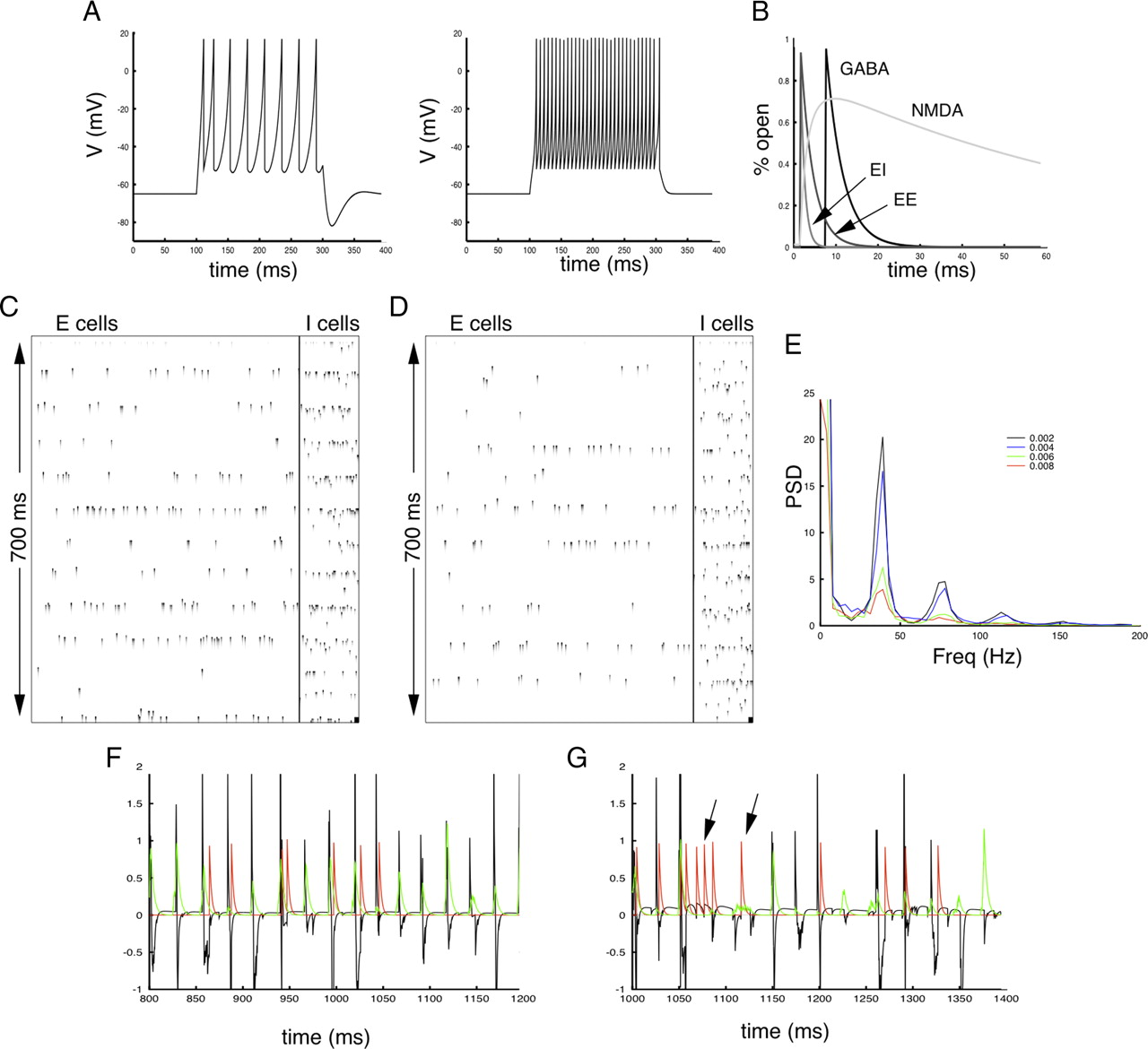
Fast AMPAR-mediated FS neuron activation is crucial for production of gamma oscillations via feedback mechanisms. A, Membrane properties of E cells (which represent pyramidal neurons) and I cells (which represent FS neurons) in the model network. B, Time course of synaptic conductances used to model excitatory and inhibitory synapses between model neurons. Note that the decay of the AMPA conductance is faster at excitatory synapses onto I cells (EI) than at excitatory synapses onto E cells (EE). In addition, the decay time of NMDA conductance is significantly longer than the decay of EI or EE. C, Raster plot showing the spike timing of E cells (left columns) and I cells (right columns) during a network oscillation episode produced in conditions of relatively low NMDAR conductance in the excitatory synapses onto I cells (gni = 0.002 mS/cm2, see Materials and Methods). D, A raster plot similar to that shown in C, but obtained during an episode of network activity in conditions of higher NMDAR conductance in excitatory synapses onto I cells (gni = 0.008 mS/cm2). E, Plot of power spectral density (PSD) showing the effects of different strengths of gni on network activity. Note that larger values of gni produced a decrease in oscillation in power and synchrony. F, Plot of the time course of the total current entering a typical I cell (black trace), the synaptic output of that FS cell (red trace), and the activity of the pyramidal cells (the scaled total AMPA output of the pyramidal cell population, green trace). These variables, shown in arbitrary units in the y-axis (negative values for the black grace indicate hyperpolarizing/outward current), were computed for network activity produced with a gni = 0.002 mS/cm2. Note the rhythmic input onto the I cell and the regular output from this I cell onto other cells in the network. G, A plot equivalent to that shown in F, for network activity produced with gni = 0.008 mS/cm2. Note that in this case, the input currents onto the FS cell remain elevated between spikes (note the much higher levels of the black curves between peaks) and can result in spikes or bursts of spikes from the FS cell that are not locked to the excitatory activity (arrows).


