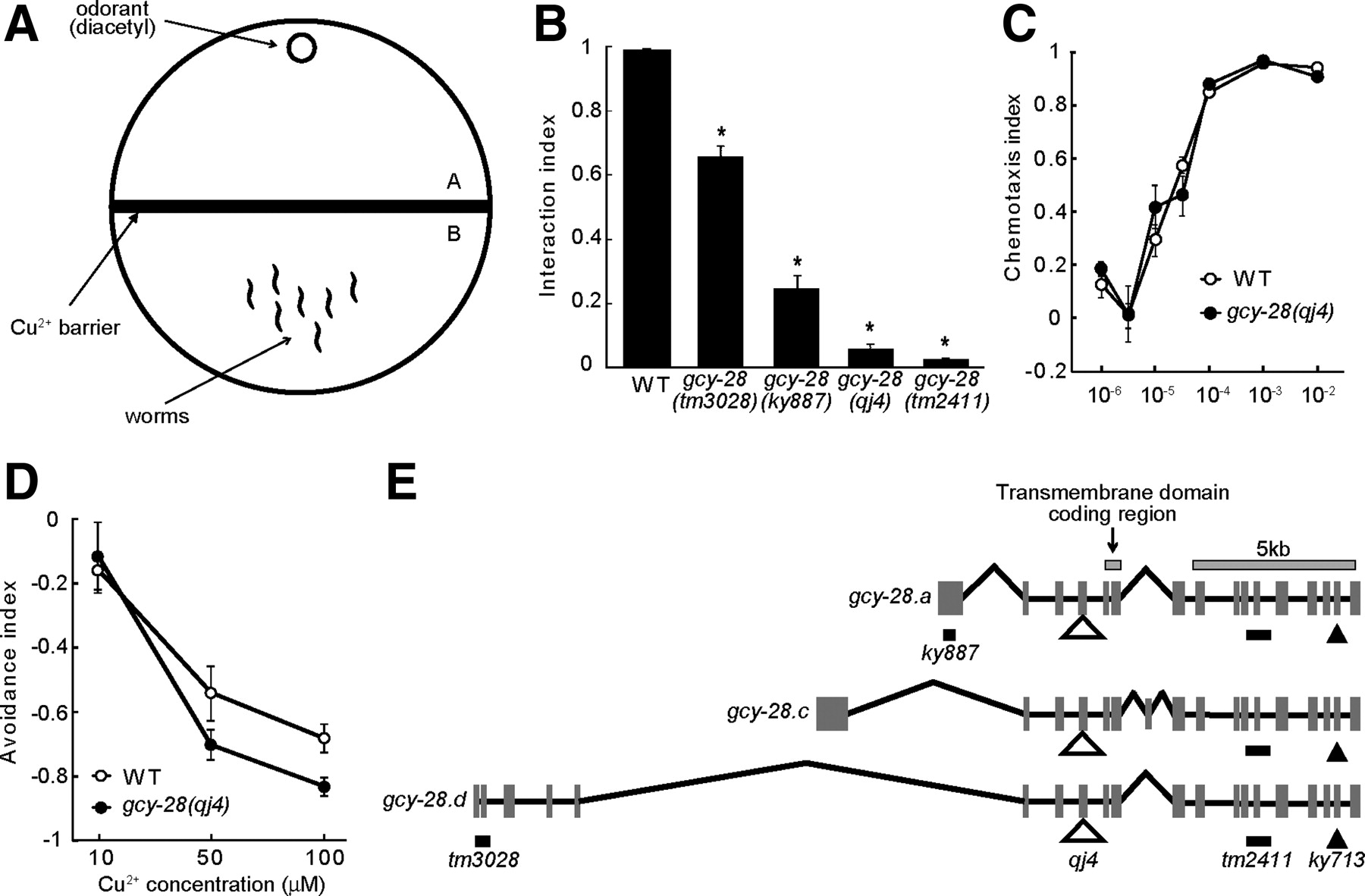
gcy-28 mutants show behavioral defects in the interaction of the two sensory signals. A, Schematic diagram for an assay to test the interaction of two sensory signals, called the “interaction assay.” Worms must cross aversive Cu2+ barrier spread on the midline of the assay plate to reach the spot containing the attractive odorant diacetyl. Forty-five minutes after the start of the assay, the numbers of worms on the original side (A) and on the odorant side (B) were scored. The index was calculated as A/(A+B). B, Phenotypes of gcy-28 mutants in the interaction assay. Error bars in B–D indicate SEM. *p < 0.01. C, Chemotaxis toward various concentrations of diacetyl of gcy-28(qj4) was analyzed by the conventional chemotaxis assay. D, Avoidance of various concentrations of Cu2+ of gcy-28(qj4) was analyzed by the quadrant assay. In all points, the differences were not significant (p > 0.01). E, Gene structure and mutations of gcy-28. Three alternative splice forms (gcy-28.a, gcy-28.c, gcy-28.d) contain partly different 5′ exons encoding the extracellular domain. Black bars indicate deletions, and a filled triangle indicates a missense mutation. An open triangle indicates Mos1 insertion. ky713 missense mutation results in substitution of an amino acid in the conserved cyclase domain (Tsunozaki et al., 2008). The alleles tm3028, ky887, and tm2411 are deletions predicted to cause a frameshift. Mos1 transposon insertion (qj4) is located in the fourth exon (I:4499749..4499750) and would result in premature termination of GCY-28 protein at the extracellular domain. WT, Wild type.


