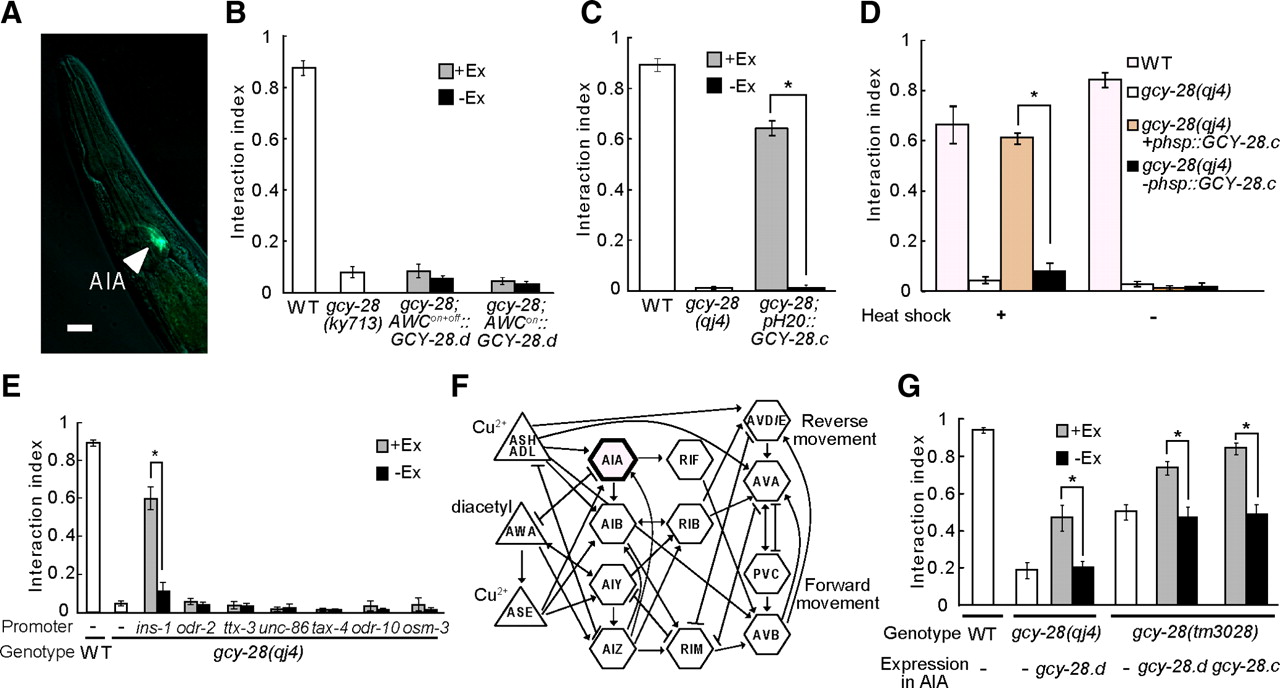
GCY-28 in the AIA interneurons is important for the interaction of two signals. A, The expression of the gcy-28.d::gfp fusion gene under control of the gcy-28.d promoter at the adult stage. The site of expression is indicated by an arrowhead. Scale bar, 10 μm. B, The phenotypes of gcy-28 mutant expressing gcy-28.d cDNA in AWCON+OFF neurons or AWCON were analyzed by the interaction assay. Worms carrying the transgene (+Ex, gray columns) and worms not carrying the transgene (−Ex, black columns) were reared on the same culture plate and subjected to the assay on the same assay plate to compare the indices. White columns indicate nontransgenic worms reared on separate culture plates and subjected to the assay on separate assay plates. C–E, The phenotypes of gcy-28 mutants expressing gcy-28.c cDNA by various promoters were analyzed by the interaction assay. The expression of H20 promoter: pan-neuron. The expression of ins-1 promoter: neurons including AIA. The expression of unc-86 promoter: several neurons including AIZ. The expression of ttx-3 promoter: AIY. The expression of odr-2 promoter: neurons including AIB. The expression of tax-4, odr-10, or osm-3 promoter: sensory neurons including ADL, ASE, ASH, AWA, and AWC. gcy-28(qj4) animals carrying phsp::gcy-28.c were heat shocked at young adult stage. F, The schematic diagram for the putative neural network for the interaction of two sensory signals, extracted from the complete circuit (White et al., 1986). Sensory neurons are shown as triangles and interneurons as hexagons. Arrows indicate chemical synapses, and lines with T-shaped ends indicate gap junctions. The AIA neurons expressing GCY-28.d are emphasized. G, gcy-28 mutants expressing gcy-28 cDNA in AIA interneurons by gcy-28.d promoter were analyzed in the interaction assay. Open bars show nontransgenic animals for comparison. B–E, G, +Ex and −Ex worms were compared. Error bars in B–E and G indicate SEM. *p < 0.01. WT, Wild type.


