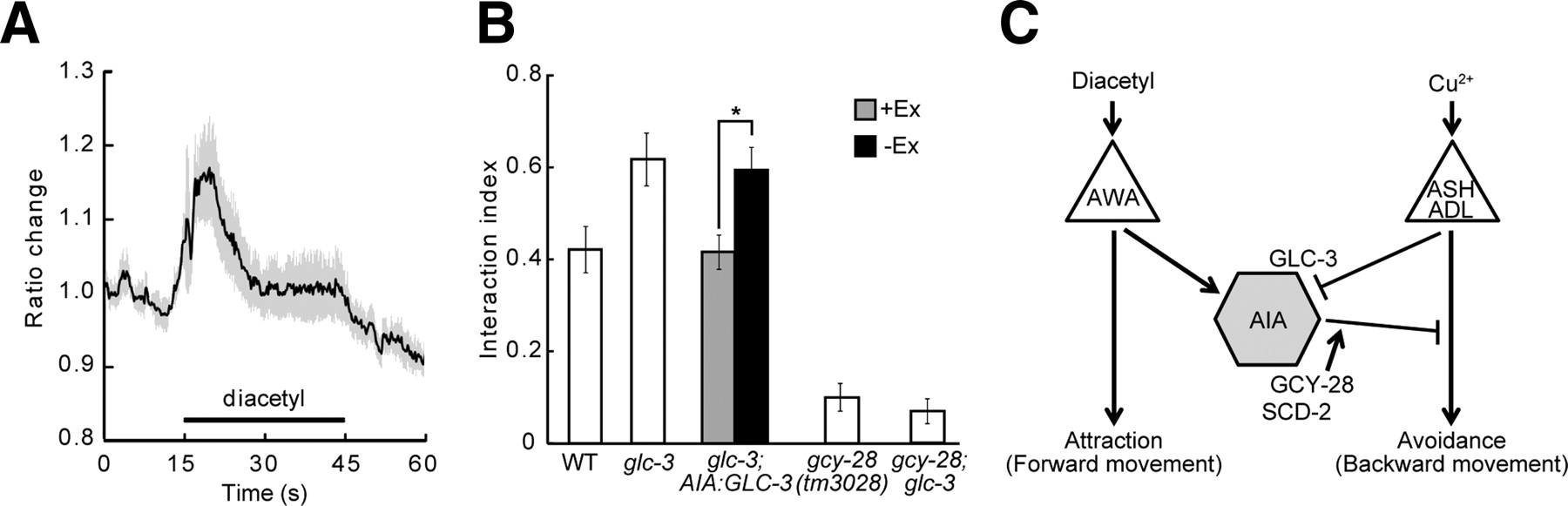
AIA interneurons receive excitatory and inhibitory inputs from distinct sensory neurons. A, Calcium responses of AWA sensory neurons to diacetyl measured by the Ca2+-sensitive fluorescent indicator Cameleon in wild-type animals. The black line indicates the average trace, and the shaded areas around the trace represent SEM (n = 3 animals). The black bar indicates the presence of diacetyl. B, The effect of mutations in glutamate-gated chloride channel GLC-3 on the behavior of wild-type animals and gcy-28 mutants in the interaction assay (100 mm copper acetate was used as Cu2+ barrier). Worms carrying the transgene (+Ex) and worms not carrying the transgene (−Ex) were compared. Error bars indicate SEM. *p < 0.01. C, A neuronal circuit model for the interaction of two sensory signals. Sensory neurons are shown as triangles, and interneurons, as hexagons. Arrows indicate excitatory connections, and lines with T-shaped ends indicate inhibitory connections. The activity of AIA interneurons would be regulated by the balance between excitatory inputs from AWA through gap junction and inhibitory inputs from ADL/ASH through GLC-3. Activated AIA interneurons would increase the relative strength of the signals for diacetyl by inhibiting the signals for Cu2+. GCY-28 and SCD-2 may enhance the inhibitory synaptic outputs from AIA.


