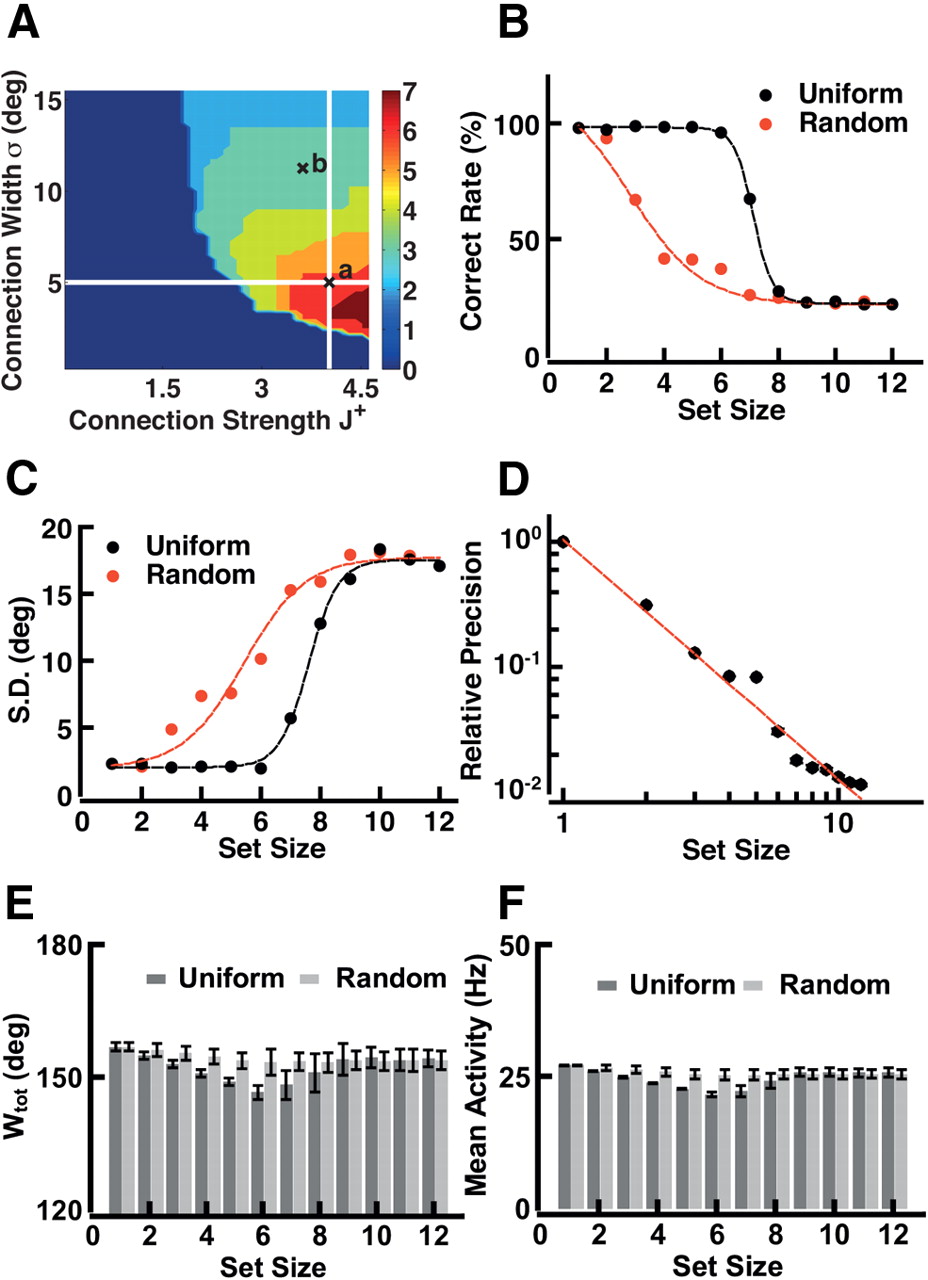
WM capacity depends on E-E connections. A, Dependence of WM capacity on E-E connectivity. The WM capacity is color coded and shown on the plane of two parameters characterizing E-E connections: the strength J+ and spatial width σ. When J+ is too weak or σ is too small (navy), the persistent activity is absent. Outside of that region, WM capacity ranges from 2 to 7; it is larger with more narrowly structured local synaptic excitation (smaller σ), which needs to be compensated by larger connection strength J+ to ensure sufficient recurrent excitation for WM maintenance. For a fixed J+ = 4.02, WM capacity increases at first and then decreases with the increasing connection width, peaking at 7 (vertical white line). For a fixed σ = 5°, WM capacity increases with the increasing connection strength (horizontal white line). B, C, Performance of a narrow connectivity network (×a in A) with uniform and random cue arrays. Correct rate and SD show a step-like transition as set size increases for uniform cue arrays (black), while there is a smooth function for random cue arrays (red). All the fitting curves are sigmoid functions. D, The relative precision for random cue arrays exhibits power-law dependence on set size. The total width of activity bumps (E) and average firing rate of pyramidal cells (F) are normalized for both uniformly and randomly distributed arrays of directional cues.


