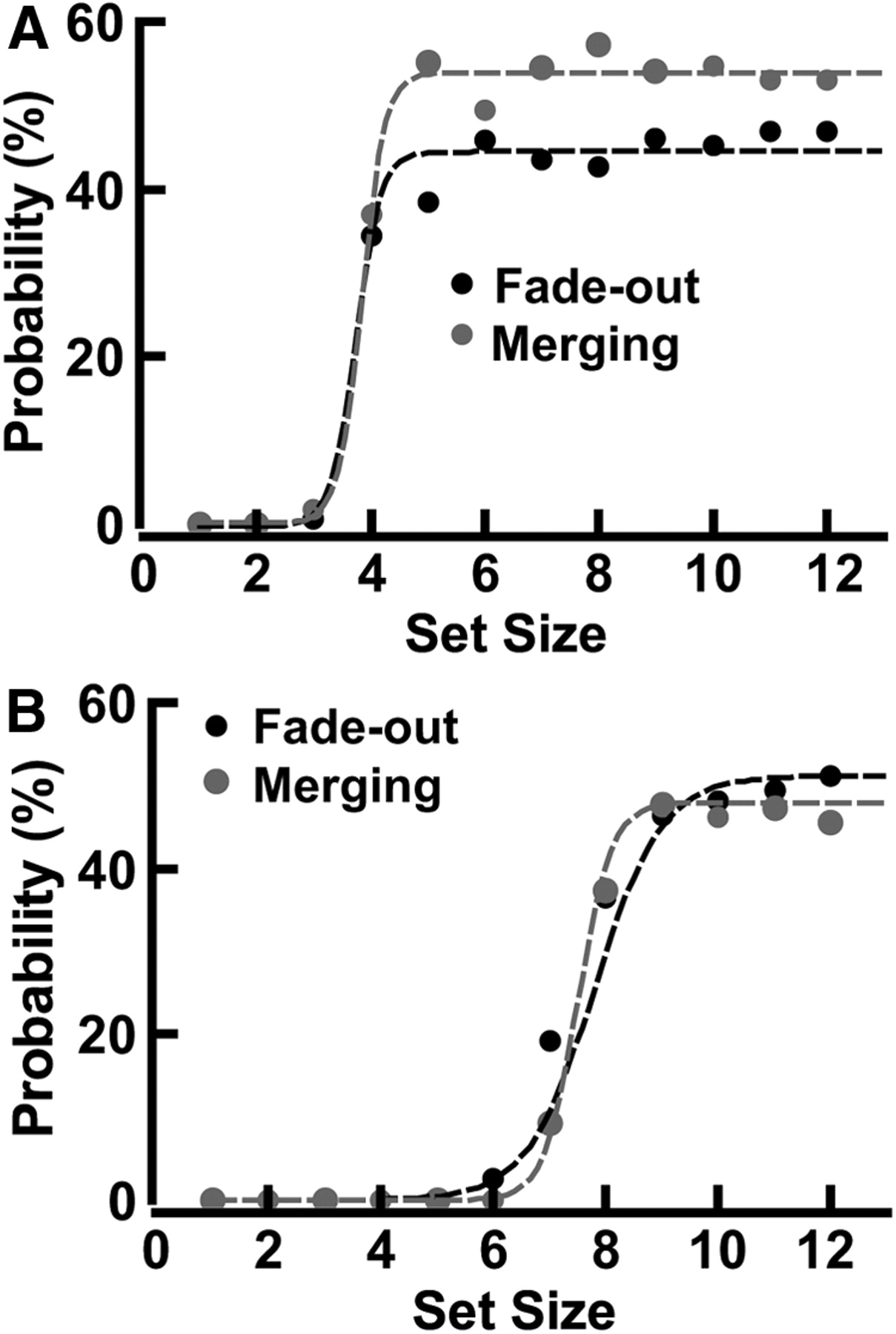
Dependence of fade-out and merging of mnemonic activity bumps on set size. The fraction of mnemonic activity bumps that fade out (black) or merge with each other (gray) during a 9 s delay is plotted as a function of set size. When set size is below WM capacity (3 in A with wide connectivity, 6 in B with narrow connectivity), activity bumps seldom fade out or merge. For a set size above WM capacity, the probabilities for merging and fade-out increase sharply. With a sufficiently large set size, a plateau is reached where the sum of the fade-out and merging probabilities is ∼100%, hence an activity bump either fades out or merges with another bump.


