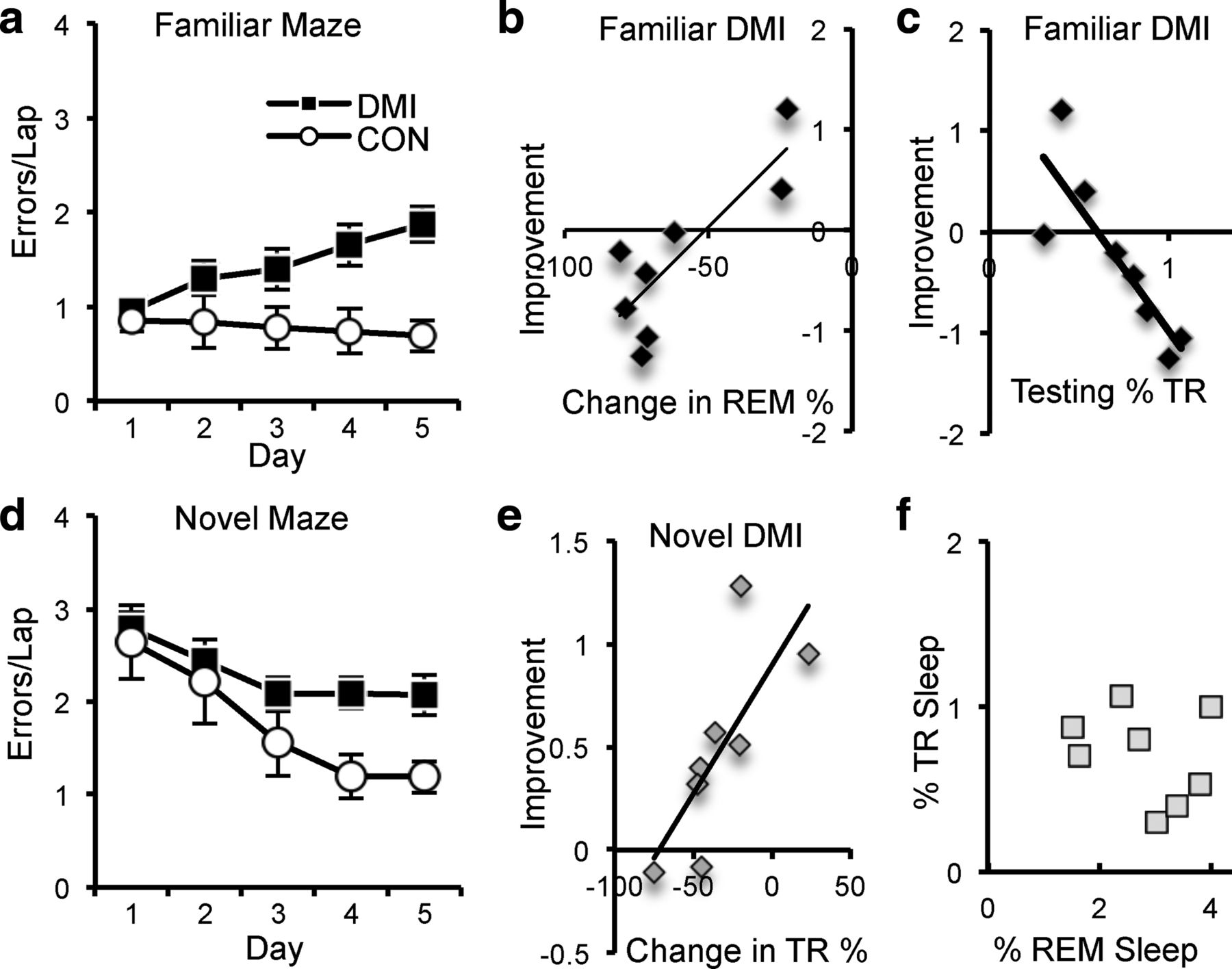
Desipramine effects on consolidation and reconsolidation. a, Effect of 10 mg/kg desipramine (filled squares) on errors per lap in a familiar spatial maze over 5 continuous days of testing relative to control-treated animals (CON; open circles). b, Relationship between decreases in REM sleep and performance in the familiar maze reconsolidation task. Changes in errors per lap relative to stable baseline performance are shown on the right vertical axis, and percent decrease in REM is shown on the horizontal axis. Pearson's correlation: r = 0.8326, p = 0.0103. c, Relationship between performance on the familiar maze and the TR sleep during DMI treatment. Note that animals with the highest amounts of TR sleep during DMI treatment also showed the most robust decreases in performance in the familiar maze environment. d, Effect of 10 mg/kg desipramine (filled squares) on new learning (Novel) over the first 5 days of testing relative to control-treated animals (open circles). Note that DMI treatment reduced improvement rates relative to control treatment, and DMI-treated animals did not reach criterion of 1 error/lap during the 5 days of testing. e, Relationship between TR state changes and novel maze performance. Improvement in errors/lap is shown on the vertical axis and percent change in TR state quantities during DMI treatment relative to baseline recordings are shown on the horizontal axis. f, Nonsignificant correlation between REM and TR sleep states during desipramine testing.


