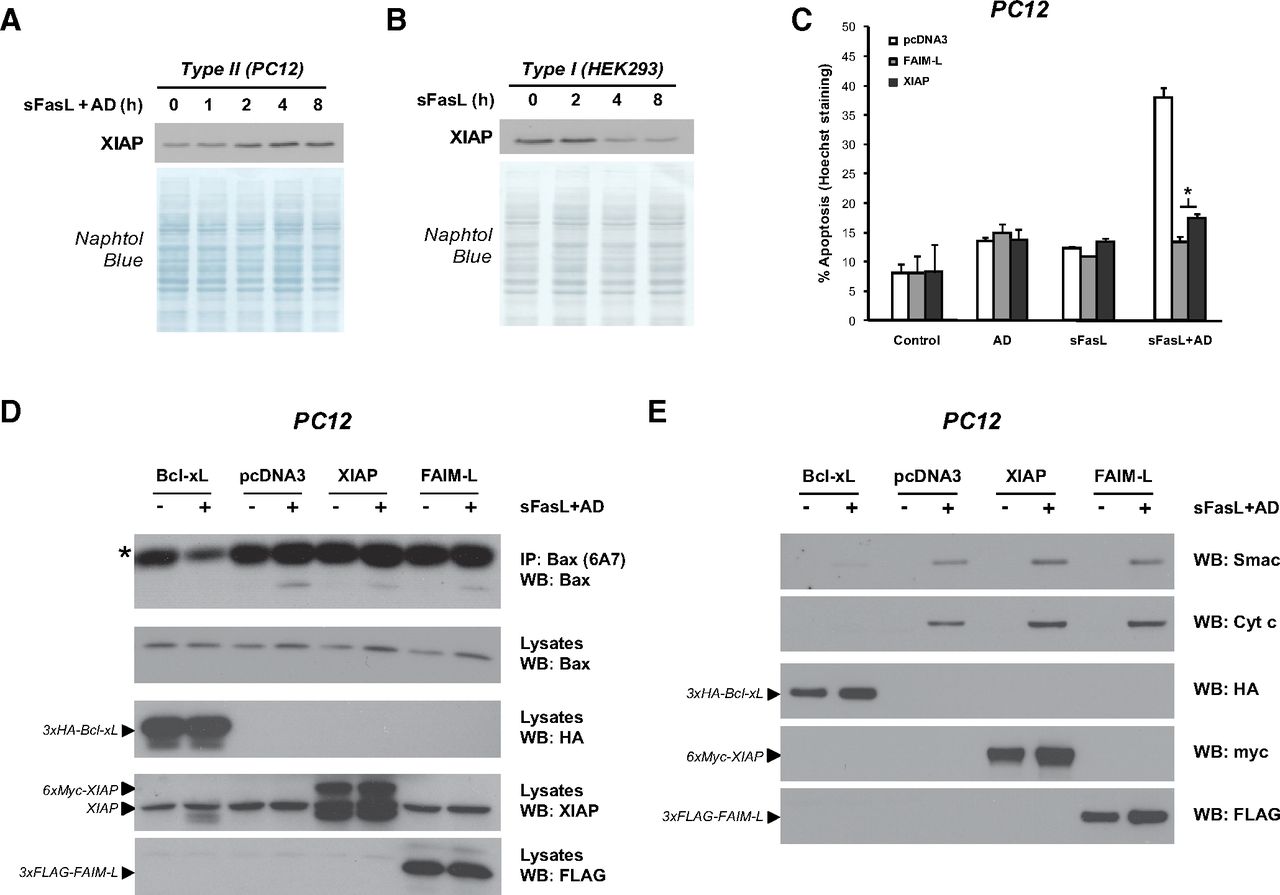
XIAP and FAIM-L protect PC12 cells from FasL-induced apoptosis downstream Bax activation. A, B, Immunoblot analysis of XIAP endogenous levels in Type II PC12 cells treated with sFasL (100 ng/ml) and AD (1 nm) (A) and Type I HEK293 cells treated with sFasL (100 ng/ml) at different time points. Membranes were stained with Naphtol Blue to confirm equal loading. C, PC12 cells were transfected with pcDNA3, 3xFLAG-FAIM-L, or 6xMyc-XIAP expression plasmids and treated with sFasL (100 ng/ml) and AD (1 nm) for 24 h. Percentage of apoptosis was assessed. Error bars indicate SD. Student test was performed, comparing transfected cells treated with sFasL+AD with their pcDNA3-transfected counterpart. *p ≤ 0.01. D, PC12 cells were transfected with 3xHA-Bcl-xL, pcDNA3, 3xFLAG-FAIM-L, or 6xMyc-XIAP expression plasmids and then treated for 24 h with sFasL (100 ng/ml) and AD (1 nm). Active Bax was immunoprecipitated before immunoblotting with a total Bax antibody. *Small chain immunoglobulin position. The transfection efficiency of Bcl-xL, XIAP, and FAIM-L was assessed in the lysate fraction. E, PC12 cells were transfected as in D and then treated for 24 h with sFasL (100 ng/ml) and AD (1 nm). Cytochrome c and Smac release to the cytosol were assessed by Western blot, as well as the transfection efficiency of Bcl-xL, XIAP, and FAIM-L.


