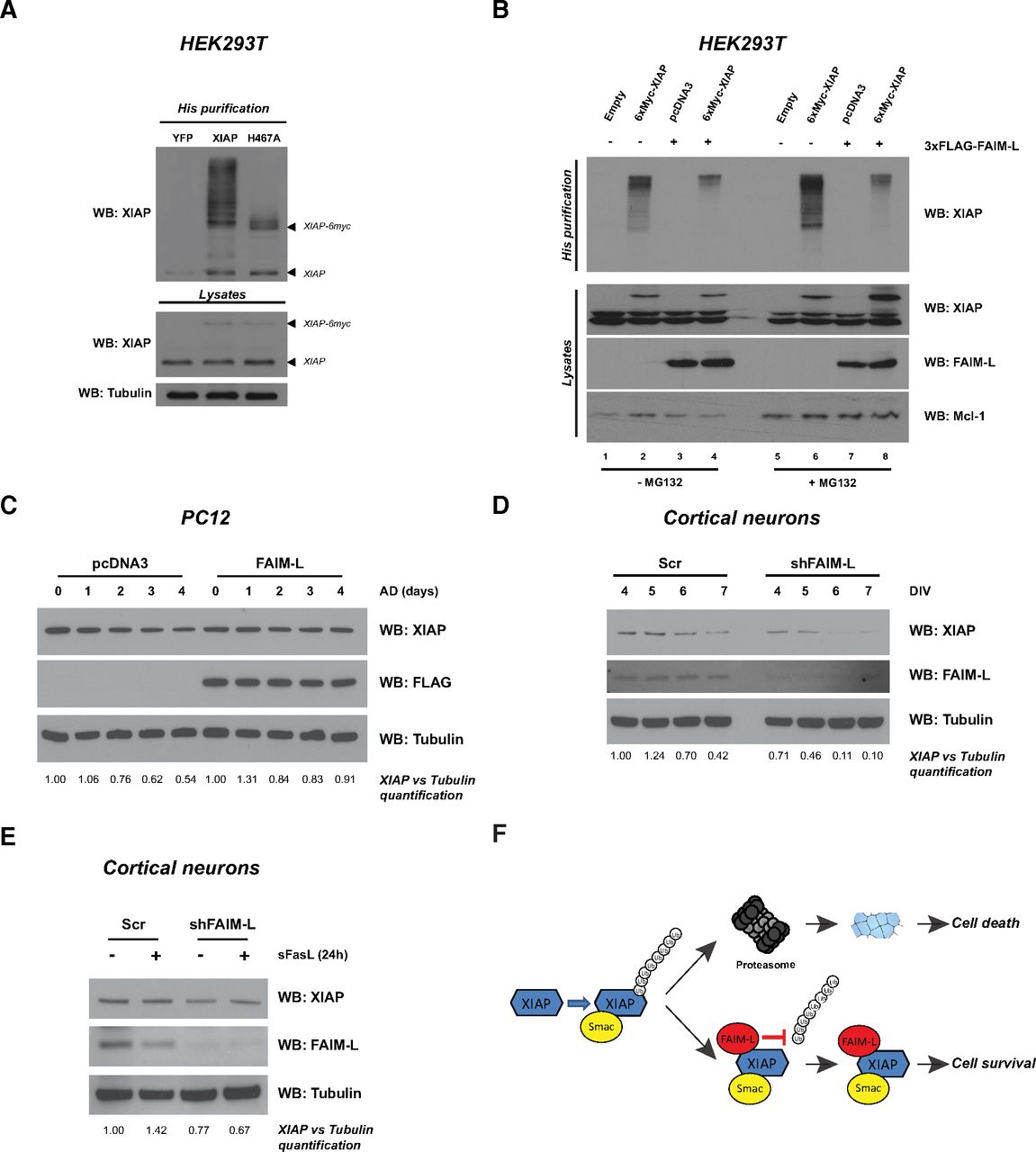
FAIM-L blocks XIAP auto-ubiquitinylation and increases XIAP stability. A, HEK293T cells were transfected with the 6xHis-ubiquitin-encoding plasmid in all conditions, together with YFP, 6xMyc-XIAP, or the 6xMyc-XIAP-H467A mutant-expressing plasmids. In vitro ubiquitinylation assay was performed, followed by XIAP blotting. B, HEK293T cells were transfected with the 6xHis-ubiquitin-encoding plasmid in all conditions, together with the 6xMyc-XIAP plasmid and the 3xFLAG-FAIM-L plasmid when indicated. Six hours before harvesting, cells were treated or not with MG132 (5 μm) and in vitro ubiquitinylation assay was performed. Lysates were loaded to confirm transfection efficiency using anti-XIAP and anti-FAIM-L antibodies. Lysates were also blotted with anti-Mcl-1 as a control of the MG132 treatment. C, PC12 cells were transfected with pcDNA3 or 3xFLAG-FAIM-L expression plasmids and treated with AD (1 nm) for several days. Cells were harvested at the time points indicated, and lysates were immunoblotted using anti-XIAP and anti-FLAG antibodies. The membrane was reblotted with anti-tubulin to ensure equal loading. D, Cortical neurons were transduced with shFAIM-L lentiviral particles upon seeding and harvested at the indicated days in vitro (DIV). Lysates were immunoblotted using an anti-XIAP antibody. The membrane was reblotted with anti-FAIM-L to assess knockdown efficiency and anti-tubulin to ensure equal loading. C, D, The experiments are each one representative of three independent experiments. E, Cortical neurons transduced with shFAIM-L lentiviral particles as in D were treated with sFasL (100 ng/ml) for 24 h, after 4 d of transduction. Lysates were immunoblotted using anti-XIAP, anti-FAIM-L, and antitubulin antibodies. C–E, The intensity of the bands relative to their respective control was quantified using the ImageJ software. F, FAIM-L mechanism of action: after an apoptotic insult, XIAP is subjected to auto-ubiquitinylation and degradation by the proteasome, leading to cell death. However, in the presence of FAIM-L, XIAP auto-ubiquitinylation is inhibited, leading to cell survival.


