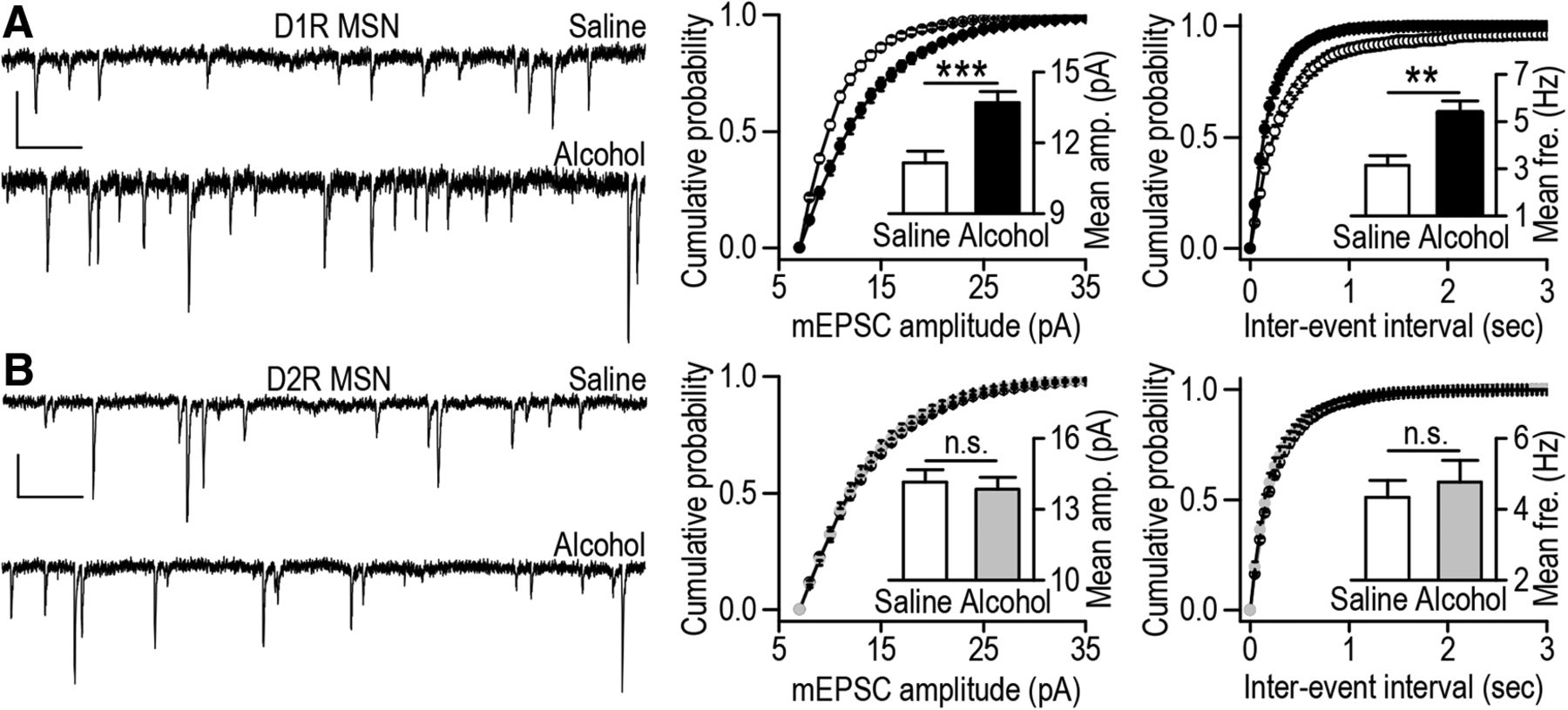
Repeated systemic administration of alcohol induces a long-lasting increase in synaptic AMPAR function in D1R but not D2R MSNs of the DMS. D1-eGFP and D2-eGFP mice were treated and DMS slices were prepared as above; AMPAR-mediated mEPSCs were recorded in fluorescent neurons in D1-eGFP (D1R MSNs) and D2-eGFP (D2R MSNs) mice. A , Systemic alcohol administration causes a long-lasting increase in the amplitude and frequency of AMPAR-mEPSCs in DMS D1R MSNs. Left, Sample traces of mEPSCs. Middle, Cumulative probability plots for mEPSC amplitude. Inset, Bar graphs comparing the mean mEPSC amplitude for saline and alcohol groups; ***p < 0.001, t test. Right, Cumulative probability plots for mEPSC interevent interval from saline- and alcohol-administered mice. Inset, Mean mEPSC frequency; **p < 0.01, t test; n = 14 (D1R MSNs) and 20 (D2R MSNs) cells from four to five mice. B , Systemic alcohol administration does not alter the amplitude or the frequency of AMPAR-mediated mEPSCs in D2R MSNs of the DMS. Left, Sample traces of mEPSCs. Middle, Cumulative probability plots for mEPSC amplitude for saline- and alcohol-treated mice. Inset, Bar graphs comparing the mean amplitudes of mEPSCs from saline and alcohol groups. Right, Cumulative probability plots for mEPSC interevent interval from saline- and alcohol-administered mice. Inset, Mean frequency of mEPSCs for saline and alcohol groups; n = 18 (D1R MSNs) and 20 (D2R MSNs) cells from six mice for each group. Calibration: A , B , 0.3 s, 10 pA.


