This Week in The Journal
- Teresa Esch, Ph.D.
Enhanced Endocannabinoid Signaling May Promote Behaviors Typical of Adolescence
Miriam Schneider, Fernando Kasanetz, Diane L. Lynch, Chris M. Friemel, Olivier Lassalle, et al.
(see pages 13975–13988)
During adolescence, reproductive hormones begin to modify brain regions involved in reproductive drives and sex-specific behaviors. At the same time, basal ganglia circuitry becomes more responsive to reward, while the executive control of brain systems involved in emotions, motivation, and cognition continues to develop. Adolescents exhibit greater emotional sensitivity, risk taking, and stress responses than children or adults, but which changes in neural systems contribute to specific behavioral changes during adolescence remain poorly understood.
The behavioral patterns of adolescent rodents—such as increases in peer-directed social interactions, exploration of new and/or potentially risky situations, and sensitivity to natural and drug rewards—are similar to those of human adolescents. Schneider et al. found, for example, that compared to adults, adolescent rats exhibited greater levels of social play, increased exploration of novel objects, increased entry into the open arms of an elevated plus maze (suggesting increased risk taking), increased intake of a sweet reward, a willingness to exert more effort to obtain reward, and increased sensitivity to cocaine.
Because previous work suggested that signaling mediated by the endocannabinoid receptor CB1R is enhanced during adolescence, Schneider et al. hypothesized that enhanced CB1R signaling promotes the observed pattern of adolescent behaviors. To evaluate this hypothesis, they examined rats harboring a point mutation that enhanced the activity of CB1Rs without affecting expression level. Consistent with the authors' hypothesis, adult mutant rats showed behavioral phenotypes similar to adolescent wild-type rats, including increased social play, risk taking, novelty seeking, and sensitivity to reward. Furthermore, administration of an inverse agonist of CB1Rs decreased sweet food intake in adult mutant rats as well as in adolescent wild-type rats.
These data support the hypothesis that increased endocannabinoid signaling contributes to at least some behaviors typical of adolescence. To support this hypothesis further, it will be necessary to examine the effects of inverse agonists of CB1R on risk taking, novelty seeking, and social play in wild-type and mutant rats. Future experiments should also examine whether enhanced endocannabinoid signaling during adolescence modulates the effects of exogenous cannabinoids.
Noradrenergic Receptors Help Shape Odor Representations
Amin MD. Shakhawat, Ali Gheidi, Iain T. MacIntyre, Melissa L. Walsh, Carolyn W. Harley, et al.
(see pages 14070–14075)
To interact optimally with their surroundings, animals must recognize important objects under differing conditions and also distinguish these objects from perceptually similar, yet unimportant objects. This is complicated by the fact that—because of ongoing fluctuations in the environment and in basal neural activity—each encounter with a given stimulus activates a different, albeit overlapping, set of neurons, and moreover, some of the same neurons are activated by perceptually similar stimuli. The ability to recognize and distinguish objects is therefore thought to require experience-driven refinement of neuronal ensembles, such that important objects activate a more consistent population of neurons over time and unimportant objects activate fewer of these neurons.
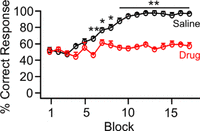
Control rats (black) learned to discriminate similar odors, but rats in which adrenergic receptors were blocked in the aPC (red) did not. See Shakhawat et al. for details.
Shakhawat et al. previously demonstrated that such experience-dependent refinement occurs in neuronal ensembles representing odors in rat anterior piriform cortex (aPC). Activated ensembles were identified by examining the distribution of Arc mRNA, which increases in the nucleus upon neuronal activation and then moves into the cytoplasm. When odor stimuli were presented 20 min apart, neurons activated by both stimuli had elevated Arc expression in both nucleus and cytoplasm. After rats learned to associate one of two similar odors with reward, the overlap in the set of neurons activated by two separate presentations of the rewarded odor increased (meaning the representation stabilized), whereas the proportion of neurons activated by both the rewarded and the unrewarded odor decreased (that is, the representations diverged).
The authors now report that blocking adrenergic receptors in rat aPC or olfactory bulb (OB) disrupted odor discrimination learning and ensemble refinement. Discrimination training caused the representation of the rewarded odor in aPC to become more stabilized and more distinct from the representation of the unrewarded odor in control rats than in rats in which adrenergic receptors were blocked in the OB. Similarly, stabilization of the rewarded odor representation in the OB was reduced after adrenergic receptors were blocked in aPC. Representations of the rewarded and unrewarded odors diverged similarly in OB of control and antagonist-treated rats, however.
These results indicate that adrenergic receptors in both aPC and the OB contribute to experience-induced refinement of neuronal ensembles representing odors. The results further highlight the importance of both stabilization and divergence of odor representations for discrimination learning, and suggest that ensembles in the OB contribute to this learning.




