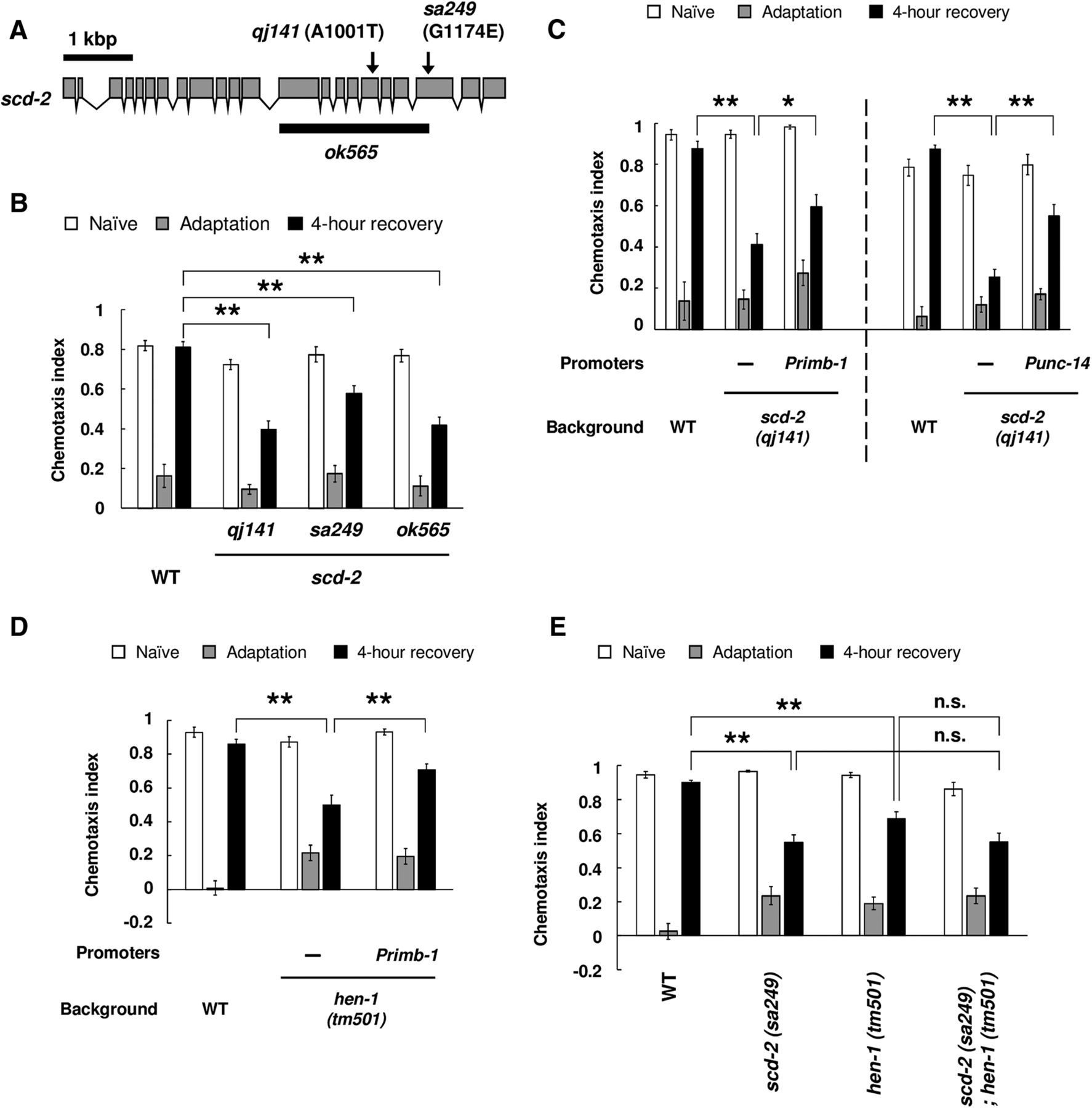
SCD-2 and HEN-1 regulate forgetting of adaptation to diacetyl in the same signaling pathway. A, Schematic depiction of the scd-2 gene and of lesions in scd-2 mutants. Arrows indicate the sites of the two scd-2 alleles, and the solid bar indicates a deleted region of ok565. B, Retention of adaptation to diacetyl in scd-2 mutant animals. Chemotaxis of naive, adapted, and 4-h-recovered animals were analyzed (n = 14, 2-way ANOVA, Fstrain(3,156) = 15.3, p < 0.001). C, Transgenic rescue of scd-2 (qj141) mutant animals by expressing wild-type gene products under the following promoters: Primb-1 and Punc-14 (Primb-1: n = 12, 2-way ANOVA, Fstrain(2,99) = 11.7, p < 0.001; Punc-14: n = 6, 2-way ANOVA, Fstrain(2,45) = 17.8, p < 0.001). D, Retention of adaptation to diacetyl in hen-1 (tm501) mutant animals (n = 8), and transgenic rescue of hen-1 (tm501) mutant animals by expressing wild-type gene products under a pan-neuronal promoter (n = 10, 2-way ANOVA, Fstrain(2,81) = 3.8, p = 0.0259). E, Retention of adaptation to diacetyl in wild-type, scd-2 (sa249); hen-1 (tm501), and each single mutant (n = 12, 2-way ANOVA, Fstrain(3,132) = 7.6, p < 0.001). *p < 0.05, **p < 0.01; post hoc t test with Bonferroni's correction (B–E). Error bars represent SEM.


