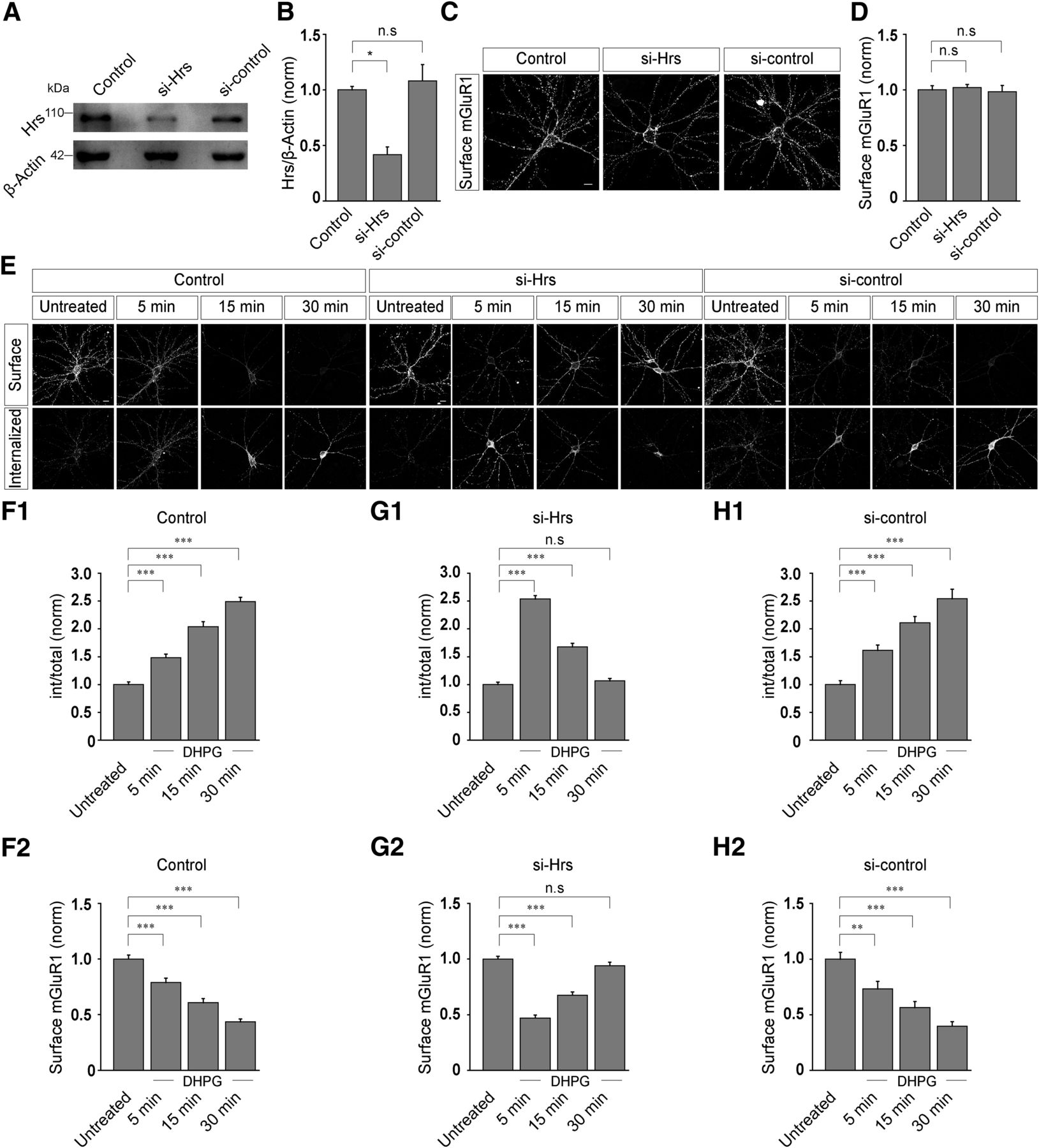
Knockdown of Hrs results in the faster recycling of mGluR1. A, B, Western blot analyses (A) and quantitation of the Western blots (B), showing the efficient knockdown of endogenous Hrs by si-Hrs. C, D, Representative images (C) and quantitation (D) suggested that acute knockdown of endogenous Hrs had no effect on the surface expression of myc-mGluR1. E, Representative cells showing that knockdown of endogenous Hrs led to the recycling of myc-mGluR1 within 30 min after 100 μm R,S-DHPG application, whereas in control cells and si-control treated cells the receptor showed progressive increase in the internalization till 30 min post-ligand application. F1, F2, Measurement of the endocytosis (F1) and surface myc-mGluR1 (F2) also suggested that in control cells myc-mGluR1 showed maximum endocytosis at 30 min after R,S-DHPG application. G1, G2, On the other hand, acute knockdown of endogenous Hrs resulted in the recycling of the receptor within 30 min after 100 μm R,S-DHPG application as evident by the quantitation of the endocytosis (G1) and measurement of myc-mGluR1 present at the cell surface (G2). H1, H2, Quantitation of the endocytosis (H1) and surface myc-mGluR1 (H2) suggested that R,S-DHPG-induced trafficking of myc-mGluR1 in si-control treated cells was similar to the control cells. Results are presented as mean ± SEM collected from three independent experiments. Scale bar, 10 μm. ***p < 0.001, **p < 0.01, *p < 0.05; n.s., p > 0.05.


