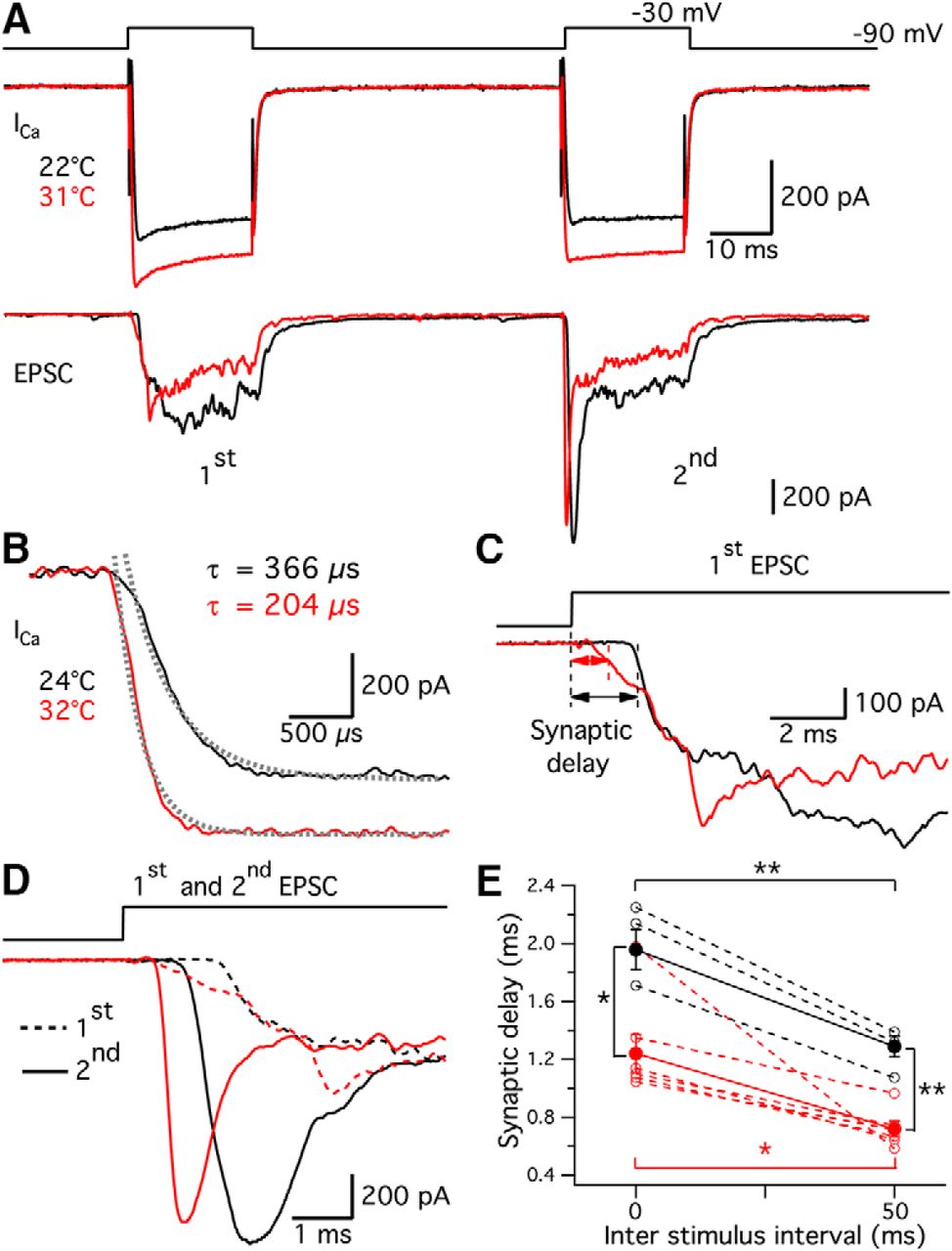
Shorter synaptic delays and faster EPSCs at high temperature. A, Two 20 ms depolarizing steps from −90 mV to −30 mV with 50 ms intervals were applied to a hair cell. Simultaneously, the postsynaptic afferent fiber was voltage-clamped at −90 mV. Average of calcium influx (ICa) elicited by the hair cell stimulus at 22°C (n = 3) and 31°C (n = 6) are shown in black and red, respectively. Synaptic vesicle glutamate release from the hair cell triggered a multiquantal EPSC in the afferent fiber. Black and red traces represent the averaged EPSCs at 22°C (n = 3) and 31°C (n = 6), respectively. Due to significant rundown, we only analyzed the first trial of each pair. Therefore, ICa and EPSC responses at room and high temperature were obtained from two different groups of pairs. B, Representative Ca2+ currents from another hair cell were triggered by a 20 ms depolarization from −90 mV to −30 mV at 24°C (black) and 32°C (red) using a P/4 protocol for leak subtraction. The activation time constant was derived from the single exponential fit after the capacitive transient (dashed lines). In this example, time constants of activation were 366 μs at 24°C (black) and 204 μs at 32°C (red). C, The rising phase of the first EPSC is shown on an expanded time scale. Synaptic delay was defined as the time between the start of stimulation and to when the EPSC reached 10% of the maximum. D, Overlay of the first (dashed lines) and the second (solid lines) EPSCs. Note the large synaptic facilitation of the second EPSCs. E, The synaptic delay of both the first (p = 0.0183, unpaired t test) and second EPSCs (p = 0.001, unpaired t test) decreased at 31°C. The first synaptic delay was longer than the second one under both 22°C (n = 3, p = 0.008) and 31°C (n = 6, p = 0.02). *p < 0.05, **p < 0.01.


