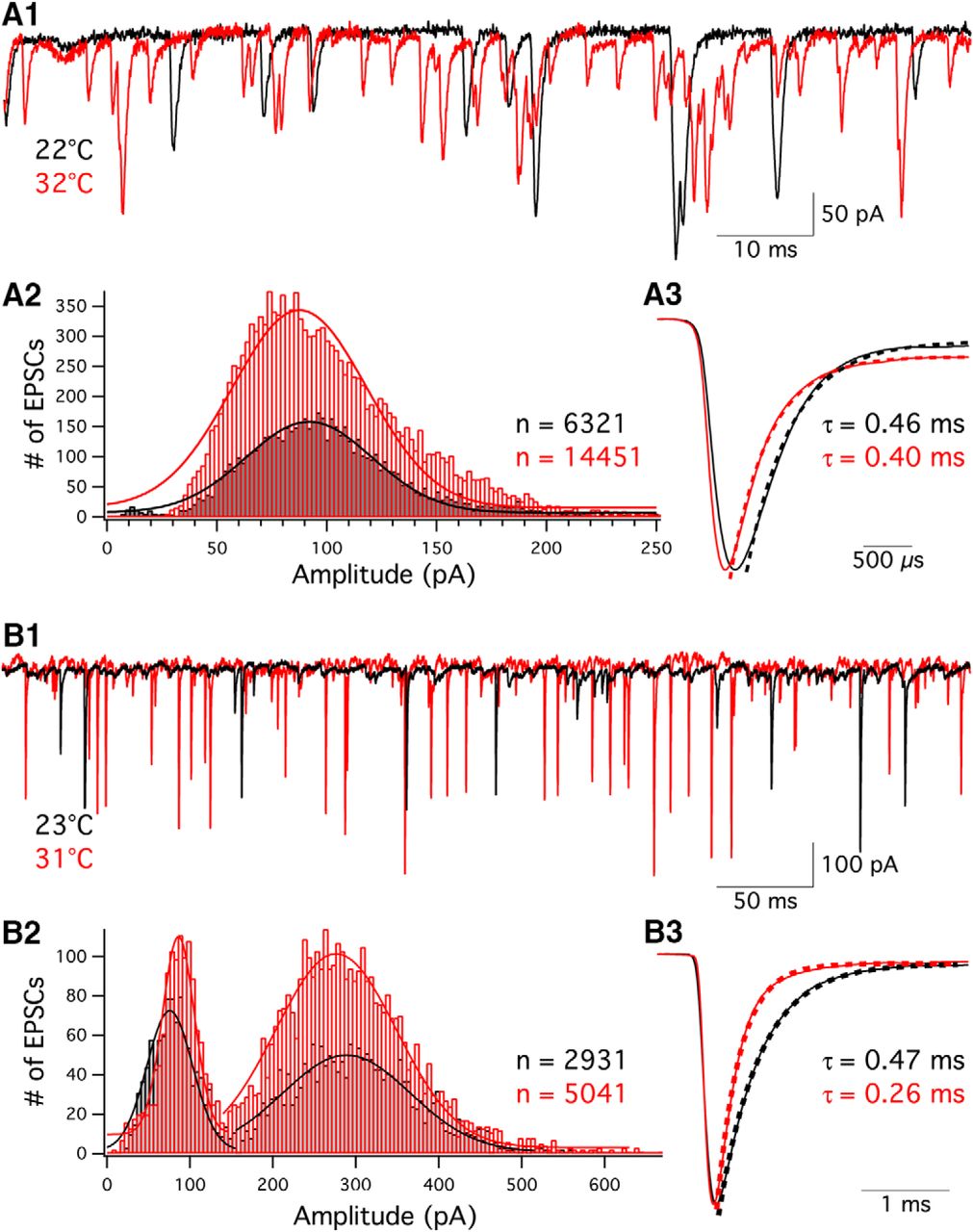
Spontaneous EPSC frequency increases at high temperature. A1, EPSCs were recorded from an afferent fiber, which was voltage-clamped at −90 mV at 22°C (black) and 32°C (red). A2, A total of 6321 and 14451 EPSCs were obtained at 22°C (black) and 32°C (red), respectively. EPSC amplitude distributions were fit with a Gaussian function. A3, Average of EPSCs recorded at 22°C (black) and 32°C (red) were normalized to their peak value. Single-exponential fits to the decay phase of averaged EPSCs showed that τdecay was 0.46 ms at 22°C (black dashed line) and 0.40 ms at 32°C (red dashed line), respectively. B1, EPSCs were recorded from another afferent fiber at 23°C (black) and 31°C (red). B2, A total of 2931 and 5041 EPSCs were obtained at 23°C (black) and 31°C (red), respectively. Two peaks are present on the amplitude distribution. EPSCs were divided into two groups according to their size: small EPSCs with amplitude <150 pA and large EPSCs with amplitude >150 pA. The EPSC amplitude distributions in each group were fit with a Gaussian function. B3, Average of EPSCs recorded at 23°C (black) and 31°C (red) were normalized to their peak value. Single-exponential fits to the decay phase of averaged EPSCs showed that τdecay was 0.47 ms at 24°C (black dashed line) and 0.26 ms at 31°C (red dashed line), respectively.


