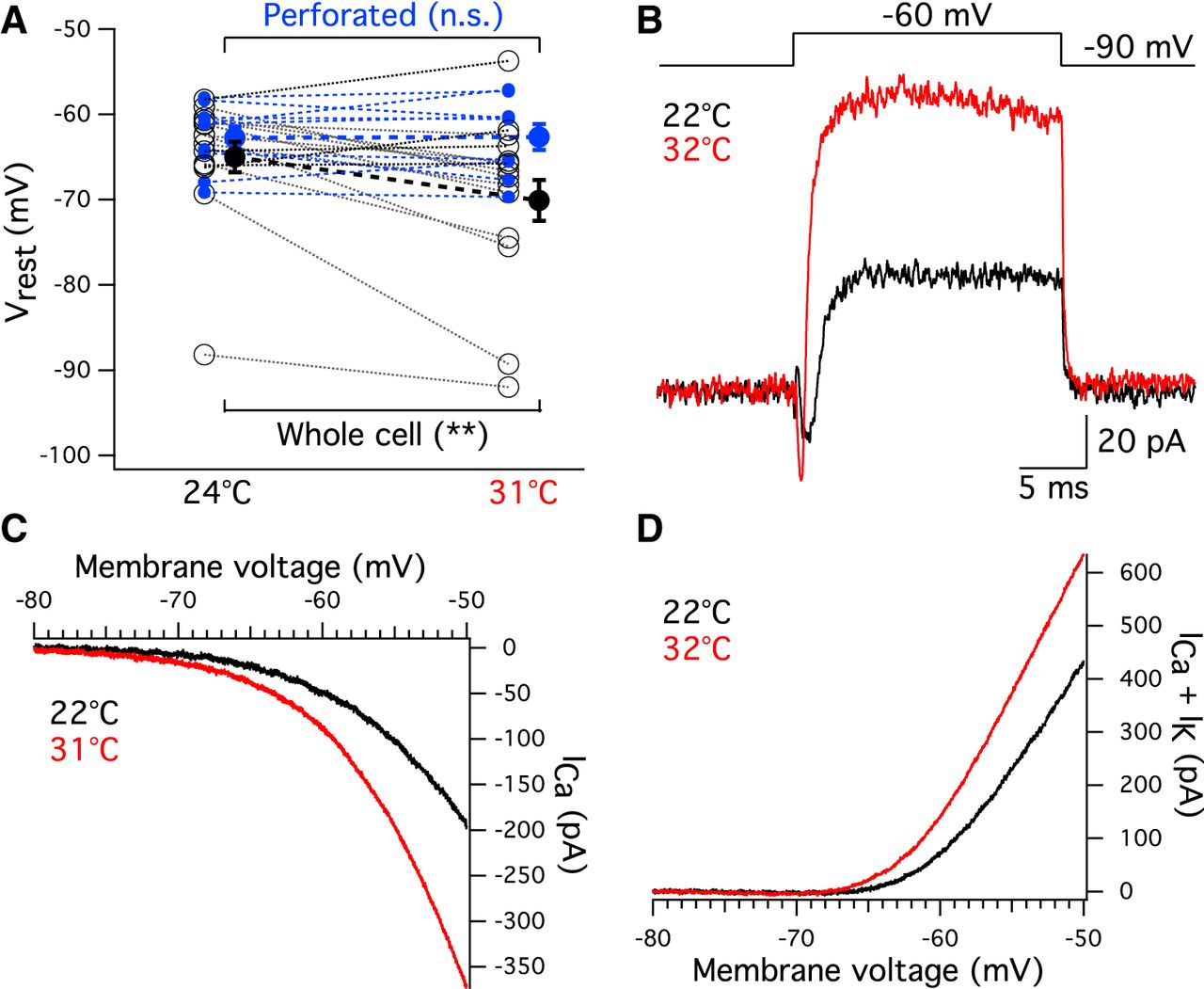
Hair cell resting membrane potential and ionic currents at high temperature. A, A K+-based internal pipette solution and current-clamp recordings with zero current injection were used to measure the Vrest of hair cells. Whole-cell recordings showed that Vrest hyperpolarized at high temperature (black circles, p = 0.006, n = 15). Gramicidin-mediated perforated patch recordings showed that Vrest remained the same at high temperature (blue dots, p = 0.88, n = 9). B, Whole-cell voltage-clamp recordings of hair cells with K+-based internal solution showed current changes in response of a step depolarization from −90 mV to −60 mV. The traces were averaged from five hair cells recorded at 22°C (black) and 32°C (red). Note the faster kinetics of the currents at 32°C. C, To reveal Ca2+ current, hair cells were patched with a Cs+-TEA-based internal solution. Hair cells were depolarized with a ramp depolarization from −90 mV to −50 mV for 400 ms at 22°C (black) and 31°C (red). The traces were averaged from five hair cells. D, Voltage-dependent K+ and Ca2+ currents were triggered by the same ramp stimulus with K+-based internal solution. The traces were averaged from 14 hair cells recorded at 22°C (black) and 32°C (red). Note how the larger outward K+ currents dominate the hair cell I–V curve. **p < 0.01.


