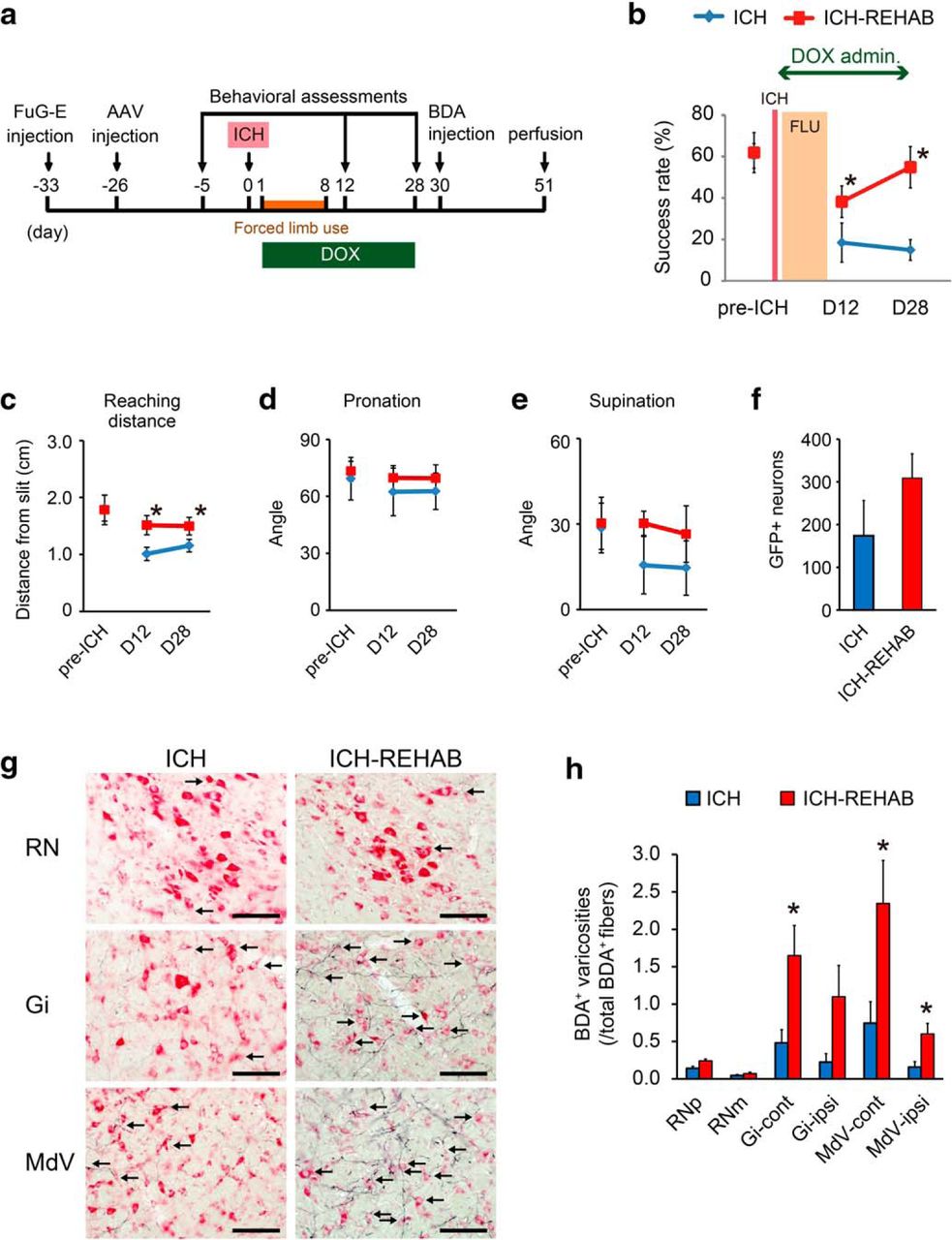
Continuous blockade of the cortico-rubral pathway from the start of intensive limb use treatment. a, Timeline of the experiments. Viral vectors were injected before ICH surgery, and DOX administration was conducted from day 1 to day 28. Behavioral assessments were performed 5 d before ICH and 12 and 28 d after ICH. After completion of the behavioral assessments, BDA was injected into the ipsilesional motor cortex to label corticofugal fibers. b, Averaged reaching success rate of ICH (n = 7) and ICH-REHAB groups (n = 8). The ICH-REHAB group showed significantly greater recovery of success rate compared with the ICH group at days 12 and 28. c–e, Qualitative analyses of reaching movements. c, Averaged reaching distance. d, e, Averaged angle of pronation (d) and supination (e) during reaching. No apparent change in the movements was detected throughout the experiment in the ICH-REHAB group. g, Representative images of BDA-labeled fibers in brainstem nuclei at day 51 (ICH: n = 5, ICH-REHAB: n = 5). In RN (top), a few BDA-labeled fibers were observed in both ICH (left column) and ICH-REHAB (right column) groups. In contrast, abundant BDA-positive fibers were found in the ICH-REHAB group in Gi (middle) and MdV (bottom). Arrows indicate varicosities apparently contacting neurons. h, Quantitative analysis of the BDA-positive varicosities in the RN and caudal reticular nuclei (Gi and MDV). Intensive limb use-treated animals exhibited a significant increase in BDA-labeled varicosities in contralateral Gi and bilateral MdV under the continuous blockade of the cortico-rubral tract. *p < 0.05 versus ICH. Data are mean ± SEM. Scale bar, 100 μm.


