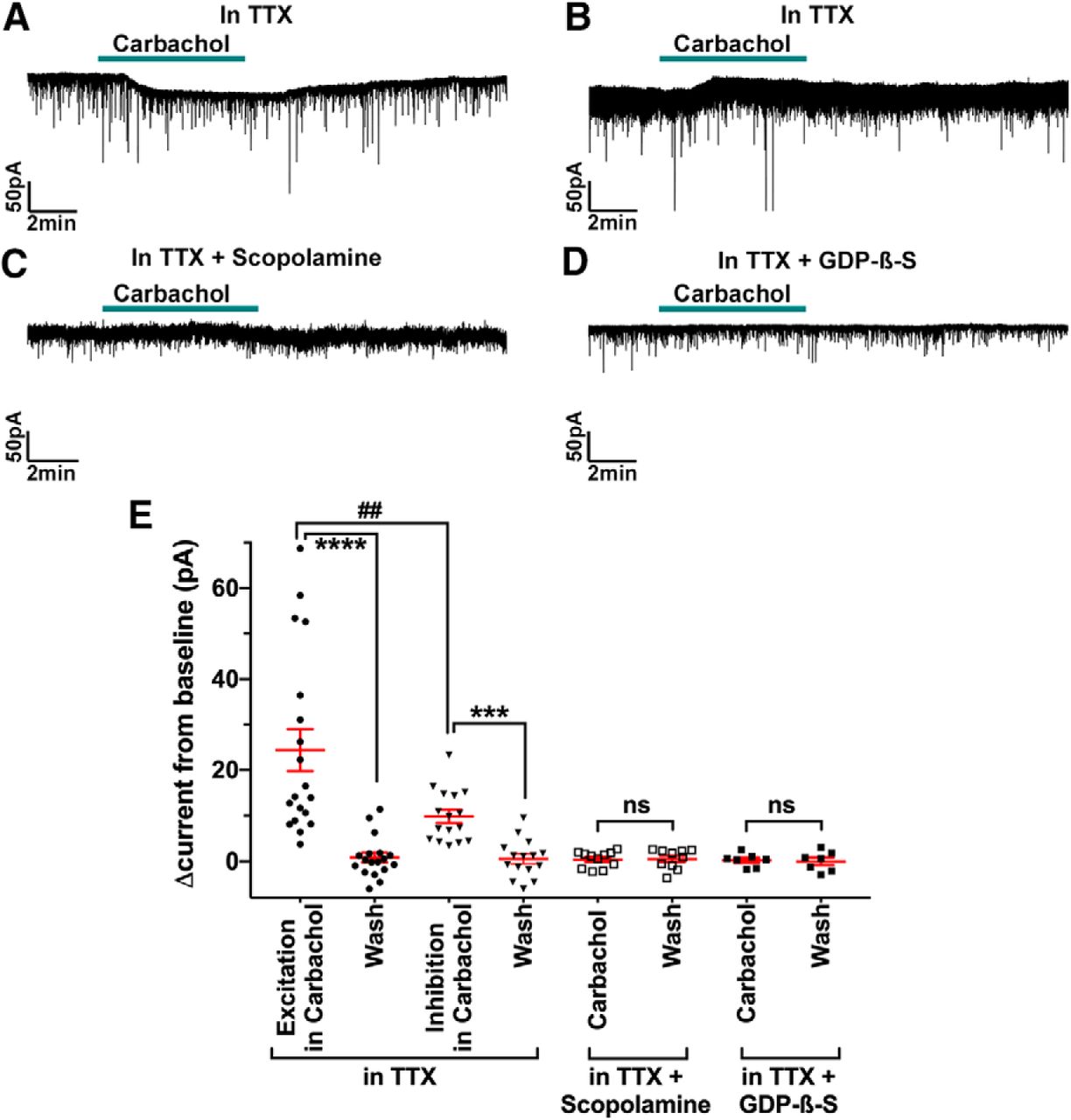
Carbachol postsynaptic effects in HMNs are mediated by muscarinic receptors. A–D, Examples of carbachol-mediated responses in HMNs. All recordings were made in voltage-clamp mode at Vh = −60 mV and in TTX 1 μm. Green bars represent the duration of carbachol application. Carbachol-mediated inward current (A; excitatory response), carbachol-mediated outward current (B; inhibitory response), and no change in holding current by carbachol in the presence in the bath of scopolamine (10 μm; C) or when adding GDP-β-S (1 mm) to the pipette recording solution (D). E, Mean amplitude of carbachol-mediated currents (mean ± SEM; Δcurrent from baseline: holding current changes from control to carbachol and to washout) in ACSF (no scopolamine) and in scopolamine. Carbachol-mediated excitation (black circles, n = 19; paired t test, ****p < 0.0001, carbachol vs washout) and carbachol-mediated inhibition (black triangles, n = 16; paired t test, ***p = 0.0004, carbachol vs washout). Carbachol-mediated excitation versus inhibition (unpaired t test, ## p = 0.006). Carbachol effects were blocked by scopolamine (white squares; n = 11; paired t test, p > 0.05, carbachol in scopolamine vs washout in scopolamine) and by GDP-β-S (black squares; n = 7; paired t test, p > 0.05, carbachol vs washout with GDP-β-S). ns, non-significant.


