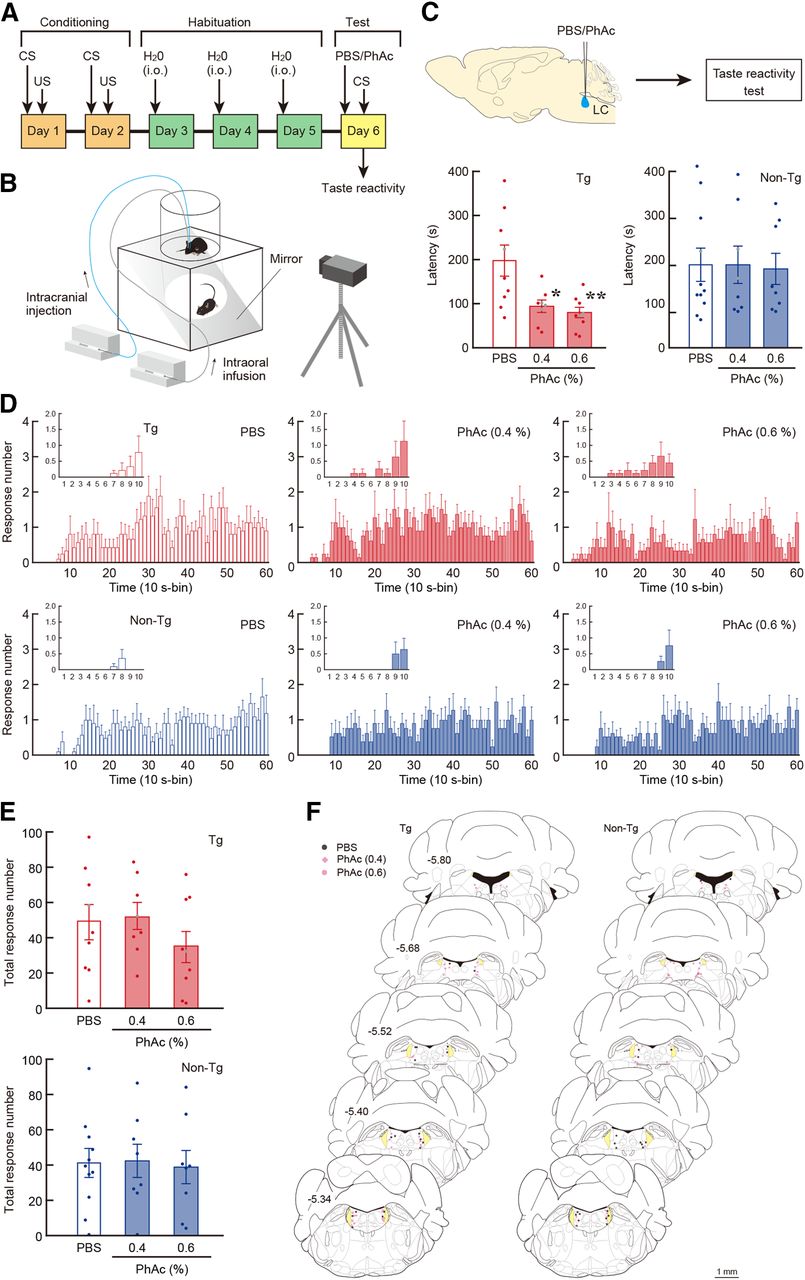
Ligand-induced LC activation enhances memory retrieval of conditioned taste aversion. A, Schedule of the taste reactivity test. In the conditioning phase, mice were presented 0.5 M sucrose as the CS, followed by an intraperitoneal injection with 0.15 m LiCl as the US (days 1 and 2). Then, the mice were habituated to intraoral (i.o.) infusion with tap water in the test chamber (days 3–5). During the test phase, mice received a bilateral LC injection (0.2 μl/site) of PBS or solution containing PhAc (0.4/0.6%) followed by CS presentation to evaluate the rejection response (day 6). B, Experimental apparatus used for the taste reactivity test. A mouse was placed in the test chamber and infused intraorally through a syringe pump, and the behavior of the animal was monitored from the bottom through an inside mirror using a digital video camera. C, Taste reactivity test showing shorter latency of rejection response by ligand-induced LC activation in the Tg mice. n = 8 or 9 for each group in the Tg mice. n = 8–11 for each group in the non-Tg mice. *p < 0.05, **p < 0.01 versus PBS in the Tg mice (Tukey's HSD test). D, Time course of aversive response number. Rejection responses during the 10 min test period were counted, and the number of responses at a 10 s bin was divided by the number of mice used in each group. Insets show the response number during the early phase (<100 s). E, Total number of aversive responses during the 10 min test. Data are presented as the mean ± SEM. Individual data points are overlaid. F, Placement sites of the injection needles into the LC (PBS and 0.4%/0.6% PhAc) for the taste reactivity test. The AP coordinates (in mm) are shown. Scale bar, 1 mm.


