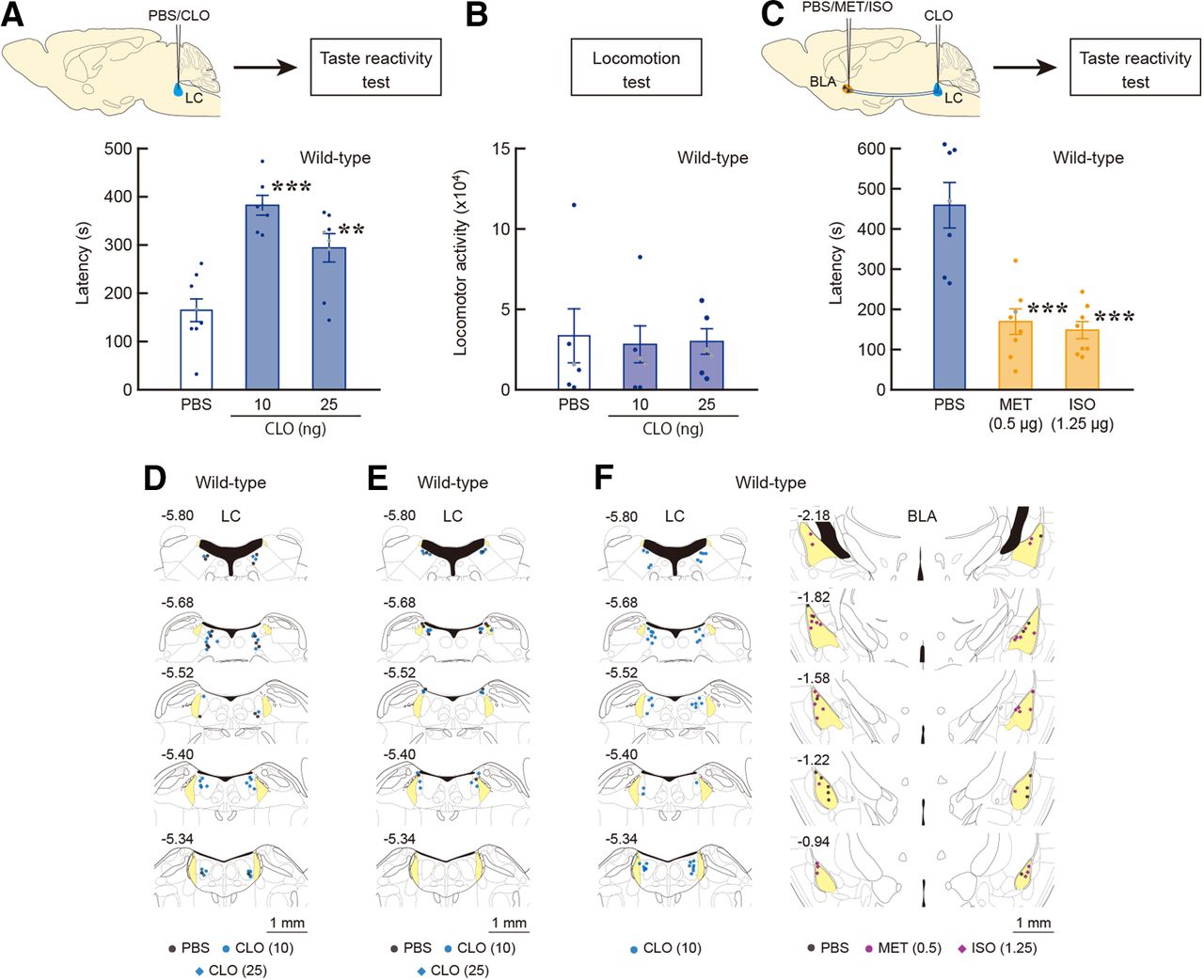
Pharmacological inhibition of LC neurons impairs memory retrieval. A, Taste reactivity test showing the lengthened latency of rejection response in wild-type mice by injection of an α2-adrenergic receptor agonist CLO (10 and 25 ng/site) into the LC. n = 7–8 for each mouse group. **p < 0.01, ***p < 0.001 versus the PBS-treated mice (Tukey's HSD test). B, Locomotion test of the wild-type mice injected with CLO (10 and 25 ng/site) in the LC. Total number of beam breaks (locomotor activity) during a 60 min period after the habituation was measured. n = 6 for each group. C, Restoration of delayed rejection response in the CLO (10 ng/site)-injected mice by intra-BLA infusion of adrenergic receptor agonists MET (0.5 μg/site) and ISO (1.25 μg/site). n = 8 for the MET- and ISO-treated groups; n = 7 for the PBS-treated group. ***p < 0.001 versus the PBS-treated mice (Tukey's HSD test). Data are presented as the mean ± SEM. Individual data points are overlaid. D, E, Placement sites of the injection needles into the LC (PBS and CLO of 10 and 25 ng/site) for the taste reactivity test (D) and locomotion test (E). F, Placement sites of the injection needles in the LC (10 ng/site CLO) and BLA (PBS, 0.5 μg/site MET, and 1.25 μg/site ISO) for the taste reactivity test. The AP coordinates (in mm) are presented. Scale bar, 1 mm.


