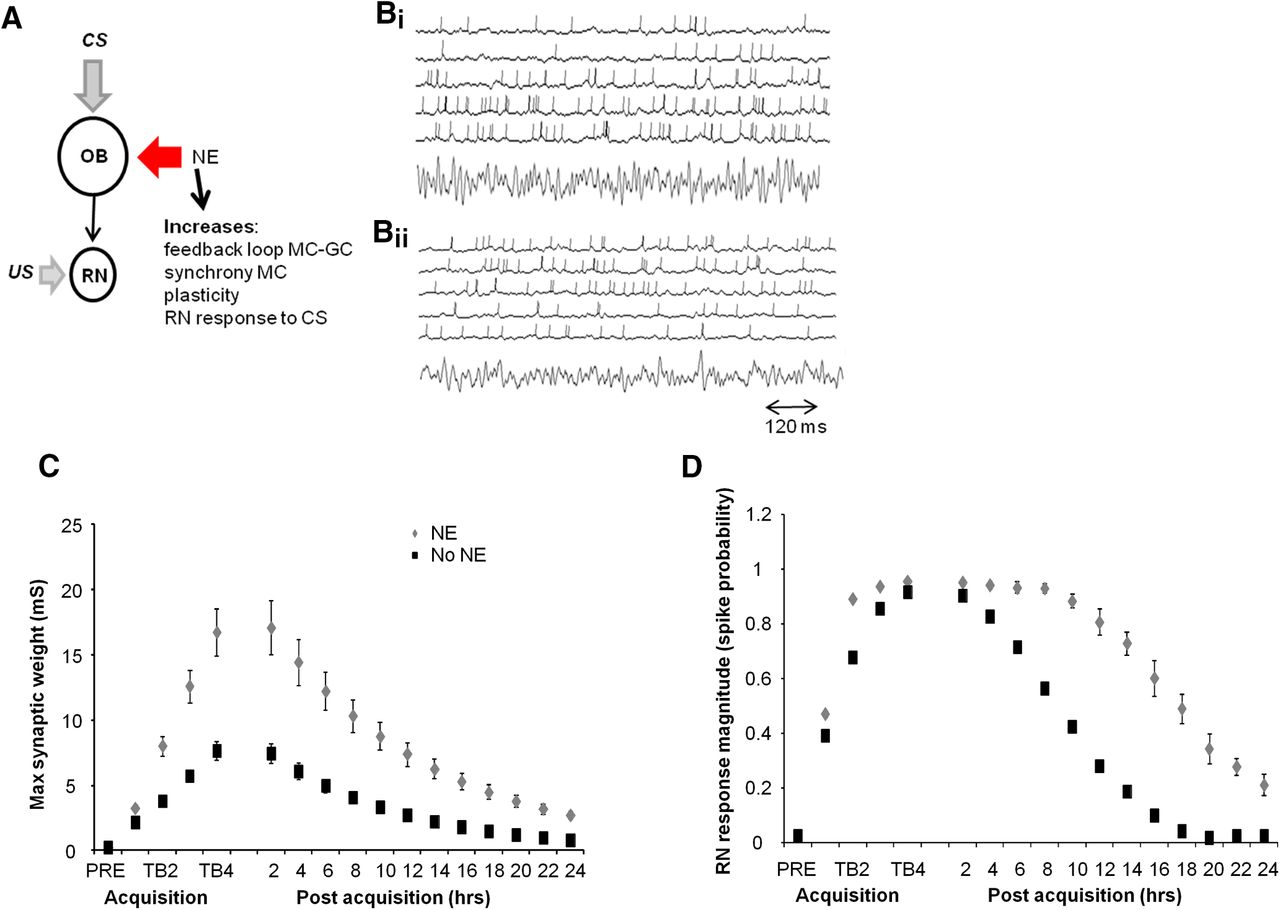
Computational modeling of bulbar NE effects on learning. A, Schematic illustration of the model structure. Olfactory stimuli are sent to OB network via activation of simulated olfactory sensory neurons. The OB network also receives NE modulatory inputs (see Materials and Methods). MCs make plastic excitatory synapses with an RN, which also receives input when a reward (US) is paired with an odor. Bi, Bii, Neural activity and field potentials in the model with (Bi) and without (Bii) NE modulation. The traces show action potentials and voltage fluctuations of representative OB neurons in the model; the bottom trace shows the simulated field potential. Note that synchrony among spikes and field potential dynamics are decreased when NE modulation is impaired in the model. C, Changes in the maximal synaptic weights between MCs and RN. The graph shows the strength of synaptic weights (in mS) as a function of trial block during acquisition, and hours elapsed during forgetting (postacquisition in hours) for simulations with and without NE modulation. Note that when NE is omitted during acquisition, synaptic weights increase less and decreases to initial values by 18 h, leading to nonrecall at the 24 h time point (compare with D). D, Response of RN (spike probability) to OB stimulation with the conditioned odor during acquisition and forgetting. RN response magnitude was measured after every trial block during acquisition and after every simulated hour during postacquisition (without US). Note that when NE modulation is omitted during acquisition, RN responses increase to the same asymptotic value, however, responses decrease more rapidly postacquisition, and by 18 h postacquisition RN responses are as low as baseline. Data are available in Extended Data Figure 4-1.


