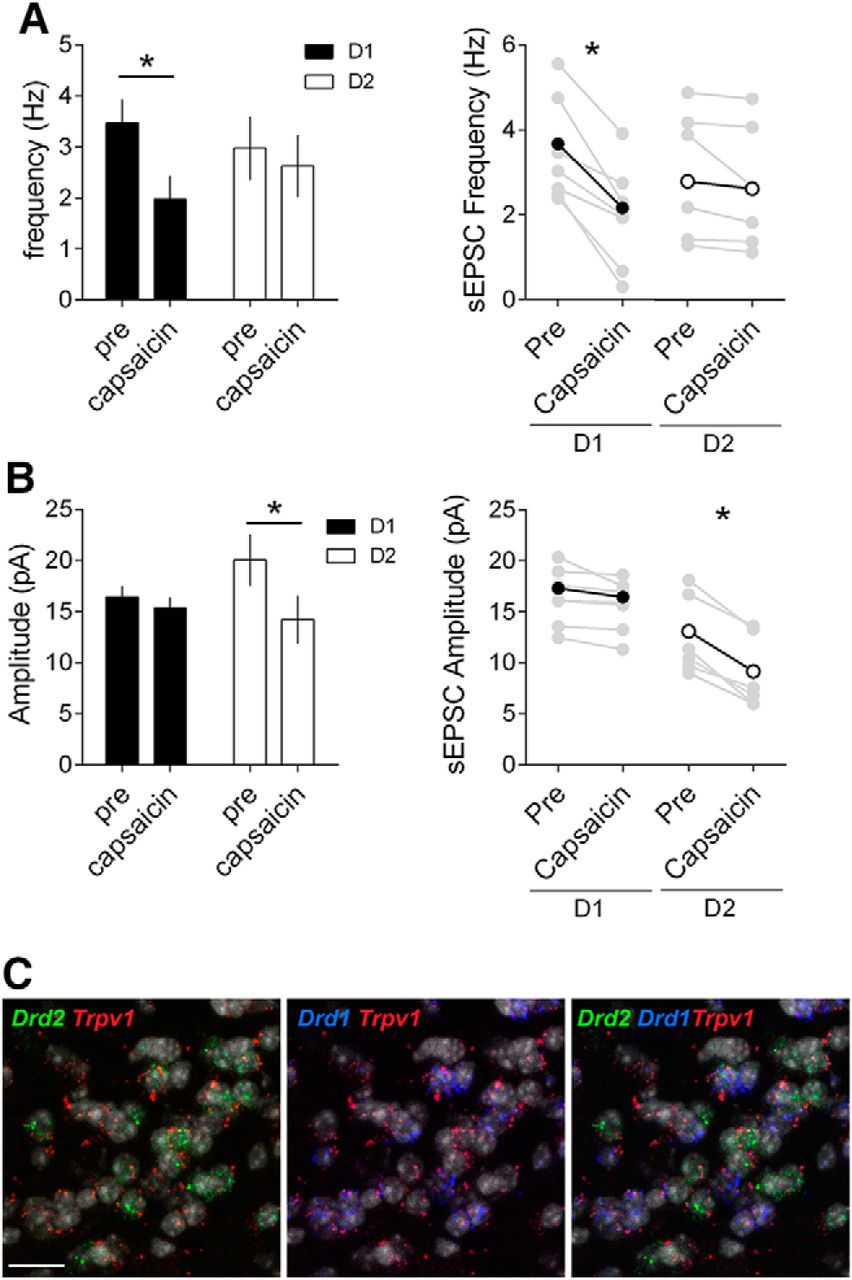
MSN-subtype-selective expression and function of TRPV1R in the NAc core. A, Left, Capsaicin reduces the frequency of sEPSC and in D1 but not D2 MSNs. Summary bar histogram comparing the mean sEPSC frequencies in D1 (black, n = 7) and D2 (white, n = 6) MSNs before and after capsaicin (10 μm). Right, Individual and averaged sEPSCs frequency experiments before (pre) and 25–30 min after capsaicin (D1 MSNs black circles, p = 0.0013 paired t test; D2 MSNs white circles p = 0.1152 paired t test). B, Left, Capsaicin reduces the amplitude of sEPSC in but not D1 MSNs. Summary bar histogram compares the mean sEPSC amplitudes in D1 (black, n = 7) and D2 (white, n = 6) MSNs before and after capsaicin. Right, individual and averaged sEPSCs amplitude (D) experiments before (pre) and 25–30 min after capsaicin (D1 MSNs black circles, p = 0.0559 paired t test; D2 MSNs white circles p = 0.0008 paired t test). All data are shown as mean ± SEM. *p < 0.05 paired t test. C, Single-molecular fluorescent in situ hybridization for Drd1 (blue), Drd2 (green), and Trpv1 (red) mRNAs in the NAc core. Slides were counterstained with DAPI (white). Scale bar, 12 μm. Note the segregation of cells expressing Drd1 and Drd2 mRNAs and the enrichment of Trpv1 mRNA in D2 MSNs.


