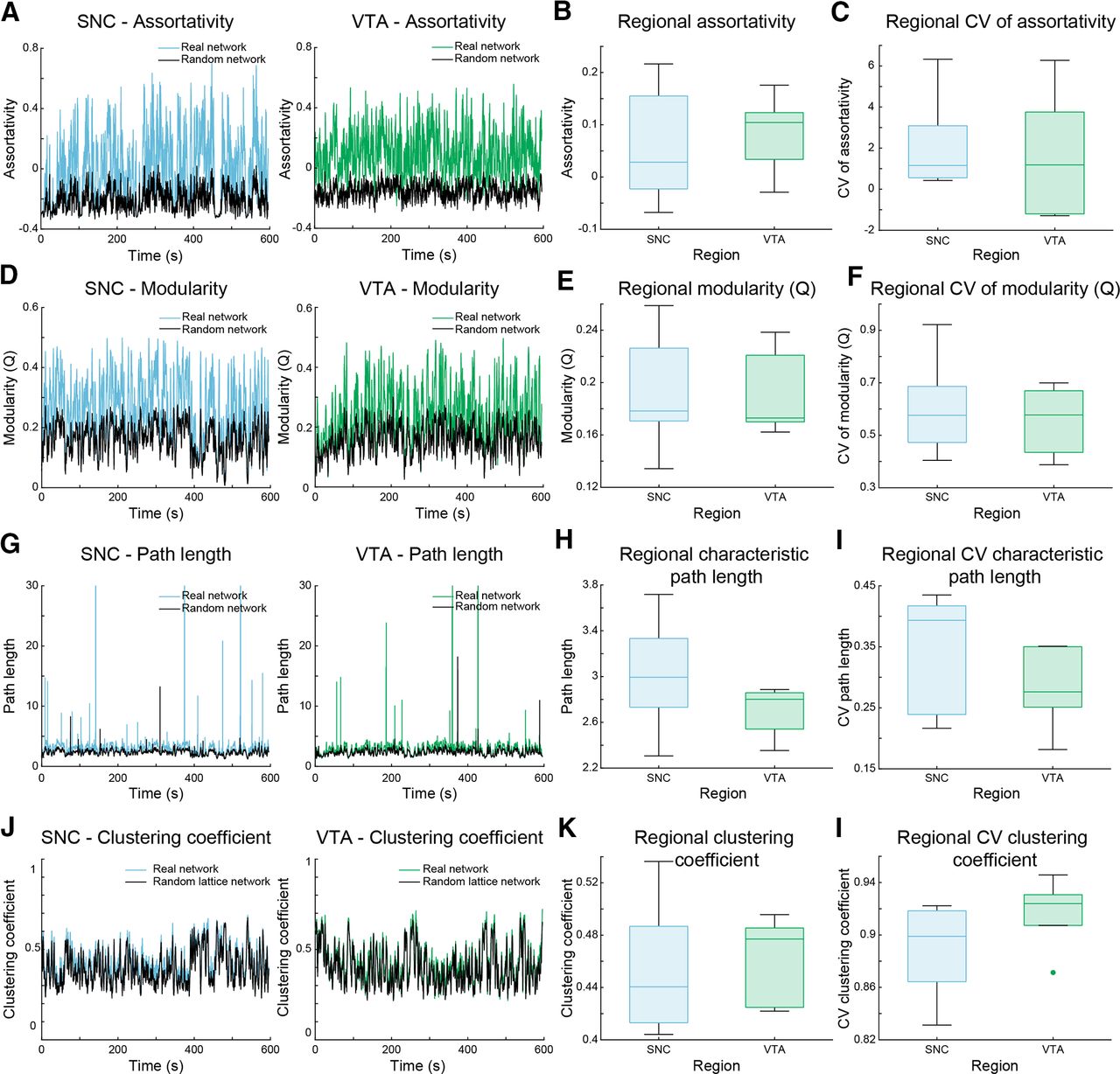
Complex network analysis reveals non-random ordered topology of SNC and VTA dopaminergic networks. We investigated regional dynamic network properties to determine whether they differ from those of a random network of equivalent size and connection distribution. Networks were assayed for (A) assortativity, preferential connectivity of a neuron to other neurons with similar (positive) or dissimilar (negative) number of connections; (D) modularity, the degree to which neurons form subspecialized groups; (G) path length, the average number of connections separating any two neurons within the network; and (J) clustering coefficient, a triplet interaction between three neurons. Across each measurement, SNC and VTA networks exhibited similar network assortativity (B), modularity (E), characteristic path length (H), and clustering coefficient (K) that were significant from their randomized counterparts and exhibited similar dynamics (C, F, I, L); n = 5–8 sections.


