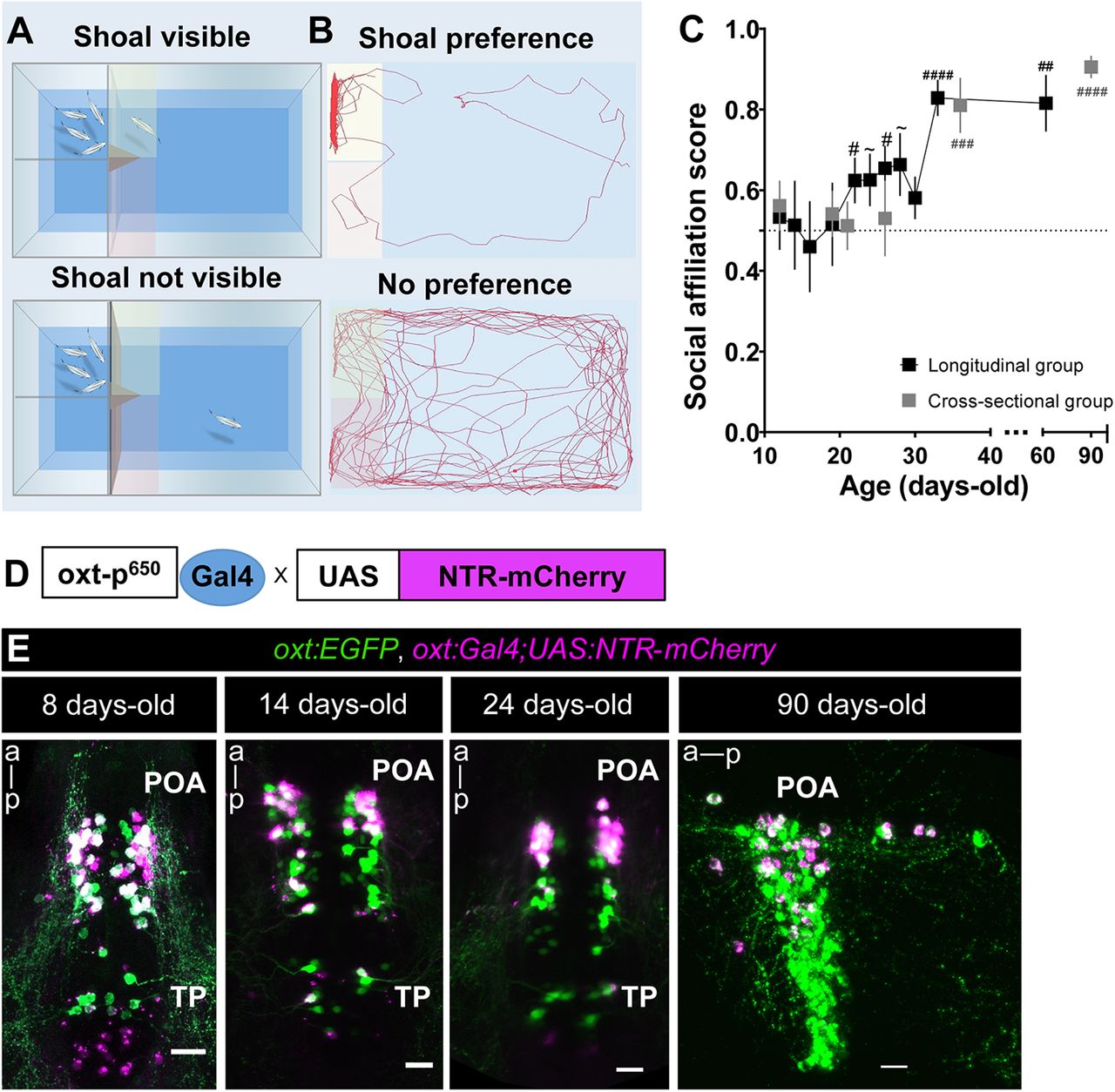
Behavioral and genetic tools to study the role of oxytocinergic neurons in adult social affiliation. A, B, Schematic representation of the visual-mediated shoal preference behavioral test setup. A, When a mixed-sex shoal stimulus is visible, focal fish spends most of the time near the shoal (top). When the shoal is not visible (bottom), the focal fish explores the entire arena equally. B, Representative tracking of the focal fish behavior. C, Ontogeny of social affiliation in zebrafish. Visual preference to associate with a shoal of conspecific fish (social affiliation score >0.5) emerges after the third week of life. Social affiliation score = %Tshoal/(%Tshoal + %Tempty). Hash (#) indicates a significant preference toward conspecifics, determined by a one-sample t test with a hypothesized value of 0.5 (chance level). Fish were tested either repeatedly throughout development (black squares, longitudinal group) or only once at certain developmental time points (gray squares, cross-sectional group). D, Chemogenetic ablation of oxytocinergic neurons. Tg(oxt:Gal4;UAS:NTR-mCherry transgene in which oxt:Gal4 drives the expression of NTR tagged with mCherry fluorescent protein (NTR-mCherry) in oxytocinergic neurons. E, Tg(oxt:Gal4;UAS:NTR-mCherry) characterization: NTR-mCherry+ cells co-localized with a subpopulation of oxt:eGFP neurons, at all developmental stages studied (8, 14, and 24 d old: whole-mount larvae confocal z-stack image, dorsal view, anterior to top; 90 d old, close-up of the POA (preoptic area)., sagittal brain slice, confocal z-stack image, anterior to left). Scale bar: 20 μm. Data presented as mean ± SEM; #p < 0.05, ##p < 0.01, ###p < 0.001, ####p < 0.0001, ∼p < 0.1 (black # relates to the longitudinal group, gray # relates to the cross-sectional group).


