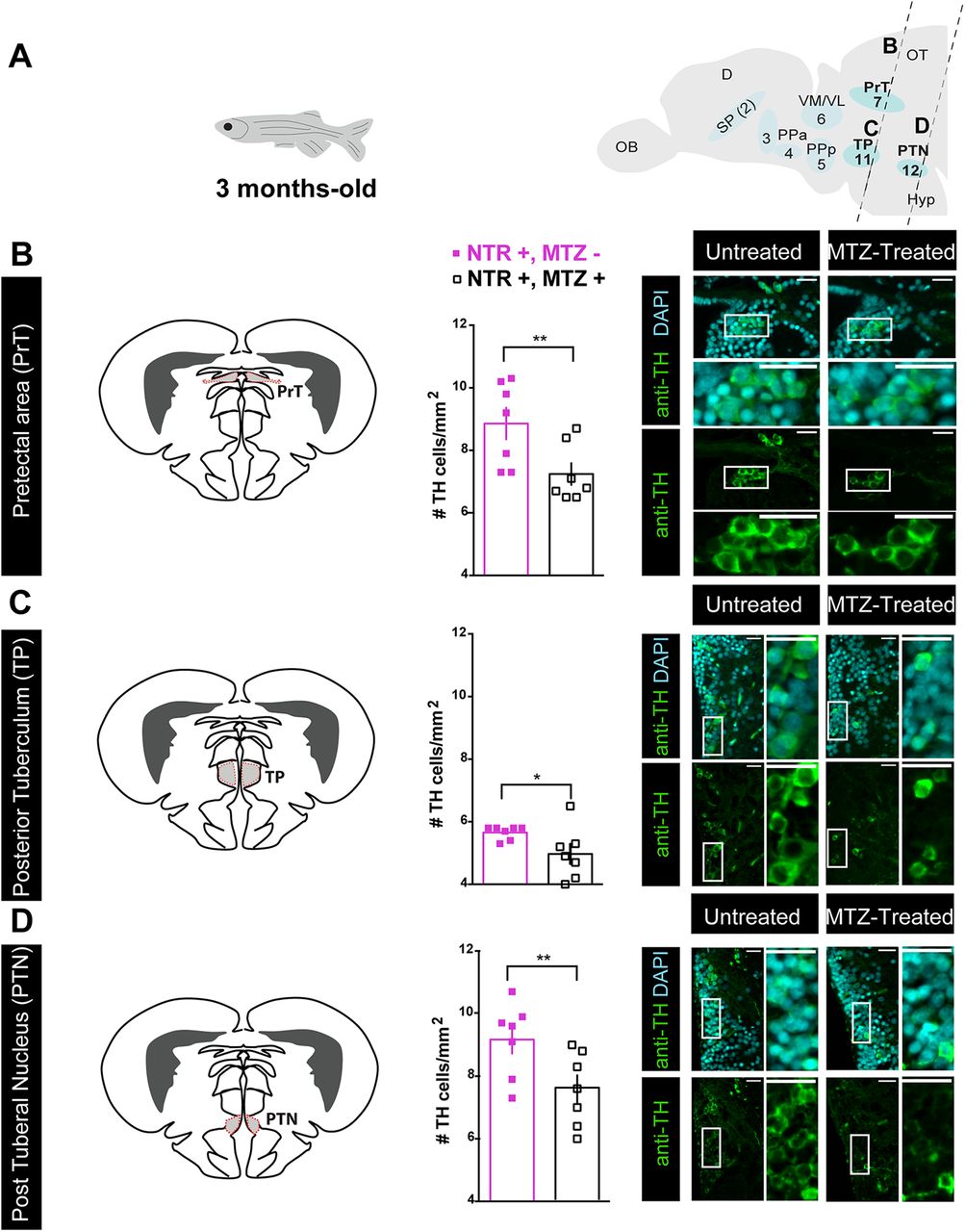
Early-life OXT ablation affects the dopaminergic system in adulthood. A, Scheme demonstrating the position of sagittal sections through a zebrafish adult brain, showing the eight dopaminergic clusters visualized by anti-TH immunofluorescence staining, and highlighting the areas that were affected by OXT neuronal ablation at 4–6 d: pretectal area (PrT), TP, and PTN. Dopaminergic groups are named according to Panula et al. (2010) and Parker et al. (2013). B–D, Quantification of TH cell density (cells/mm2; mean of five sampled slices for each area, see Materials and Methods for details) in brains of adult fish untreated (NTR+, MTZ–) or MTZ treated at 4–6 d old (NTR+, MTZ+) and respective representative images in: (B) pretectal area (PrT), (C) TP, and (D) PTN. Scale bar: 20 μm. Data presented as mean ± SEM. Full squares: untreated fish (NTR+, MTZ–); open squares: MTZ-treated fish (NTR+, MTZ+); *p < 0.05, **p < 0.01. D, dorsal telencephalon; Hyp, hypothalamus; OB, olfactory bulb; OT, optic tectum; SP, subpallium (includes Vv, Vd, and Vs); TP, posterior tuberculum; PTN, post tuberal nucleus; Vl, ventrolateral thalamic nucleus; VM, ventromedial thalamic nucleus. See Extended Data Figure 6-1.


