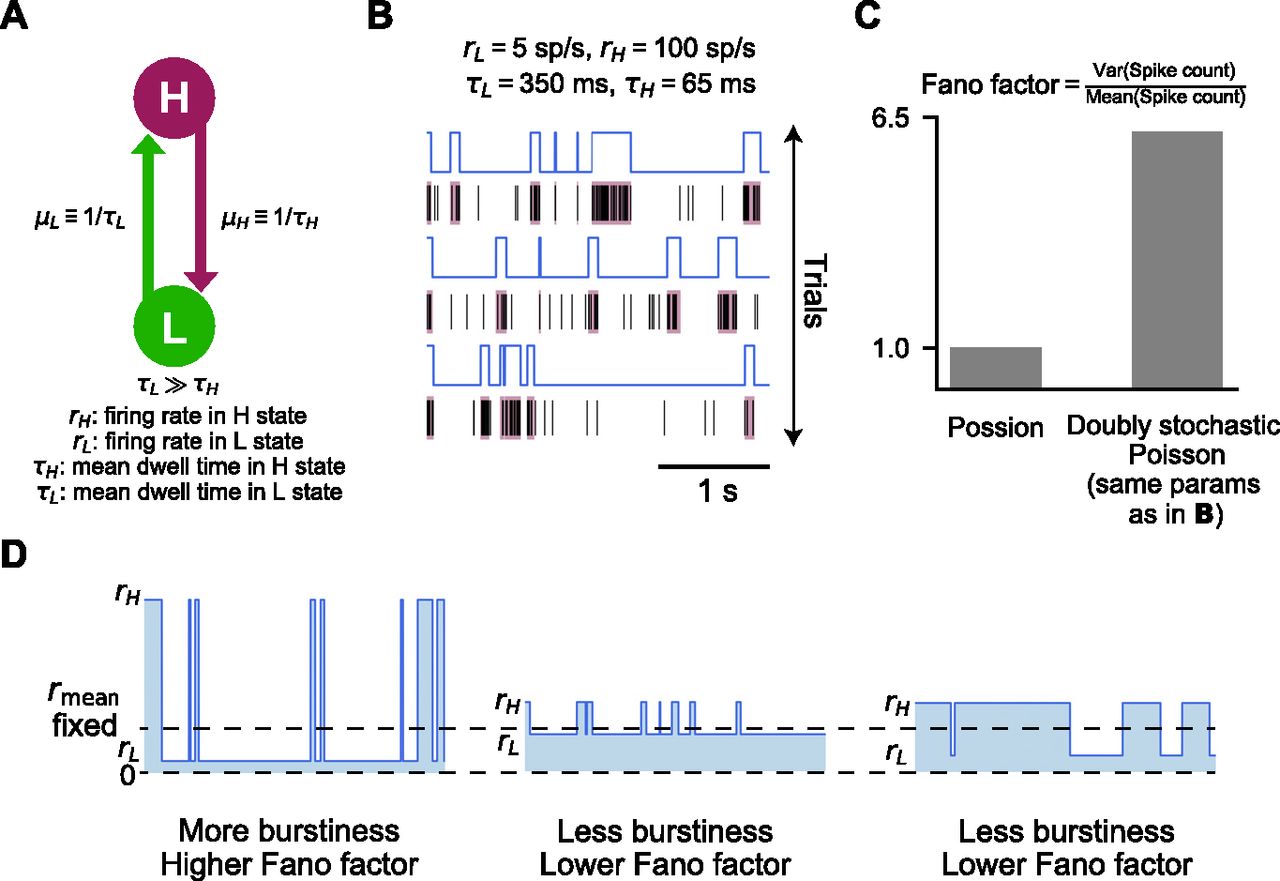
Two-state telegraph process as a doubly stochastic Poisson model of neuronal burst spiking. A, Neuronal spiking is modeled as a doubly stochastic Poisson process with the underlying firing rate following a random two-level
telegraph process. H and L denote the high and low firing states, with respective firing rates rH and rL, transition rates leaving the states μH and μL, τH and τL are the mean dwell time in each state. B, Three sample trials of model-simulated telegraph processes with the corresponding generated spike trains. The model parameters
used here are in a biophysically plausible range: rL = 5 sp/s, rH = 100 sp/s, τL = 350 ms, τH = 65 ms. Colored bursts typically occur in the high firing state. C, Any homogeneous Poisson process with constant firing rate has FF equal to 1, whereas the example doubly stochastic Poisson
process, defined in B, has FF equal to 6.15. D, The model in general can generate different levels of burstiness at fixed mean firing rate rmean by tuning the four parameters. The intermittent bursting regime is characterized by low rL, high rH, and low <mml:math display="inline"><mml:mrow><mml:mfrac><mml:mrow><mml:msub><mml:mi>τ</mml:mi><mml:mi>H</mml:mi></mml:msub></mml:mrow><mml:mrow><mml:msub><mml:mi>τ</mml:mi><mml:mi>L</mml:mi></mml:msub></mml:mrow></mml:mfrac></mml:mrow></mml:math>τHτL. Less burstiness can be achieved by raising the low firing rate rL, or by increasing the ratio <mml:math display="inline"><mml:mrow><mml:mfrac><mml:mrow><mml:msub><mml:mi>τ</mml:mi><mml:mi>H</mml:mi></mml:msub></mml:mrow><mml:mrow><mml:msub><mml:mi>τ</mml:mi><mml:mi>L</mml:mi></mml:msub></mml:mrow></mml:mfrac></mml:mrow></mml:math>τHτL.


