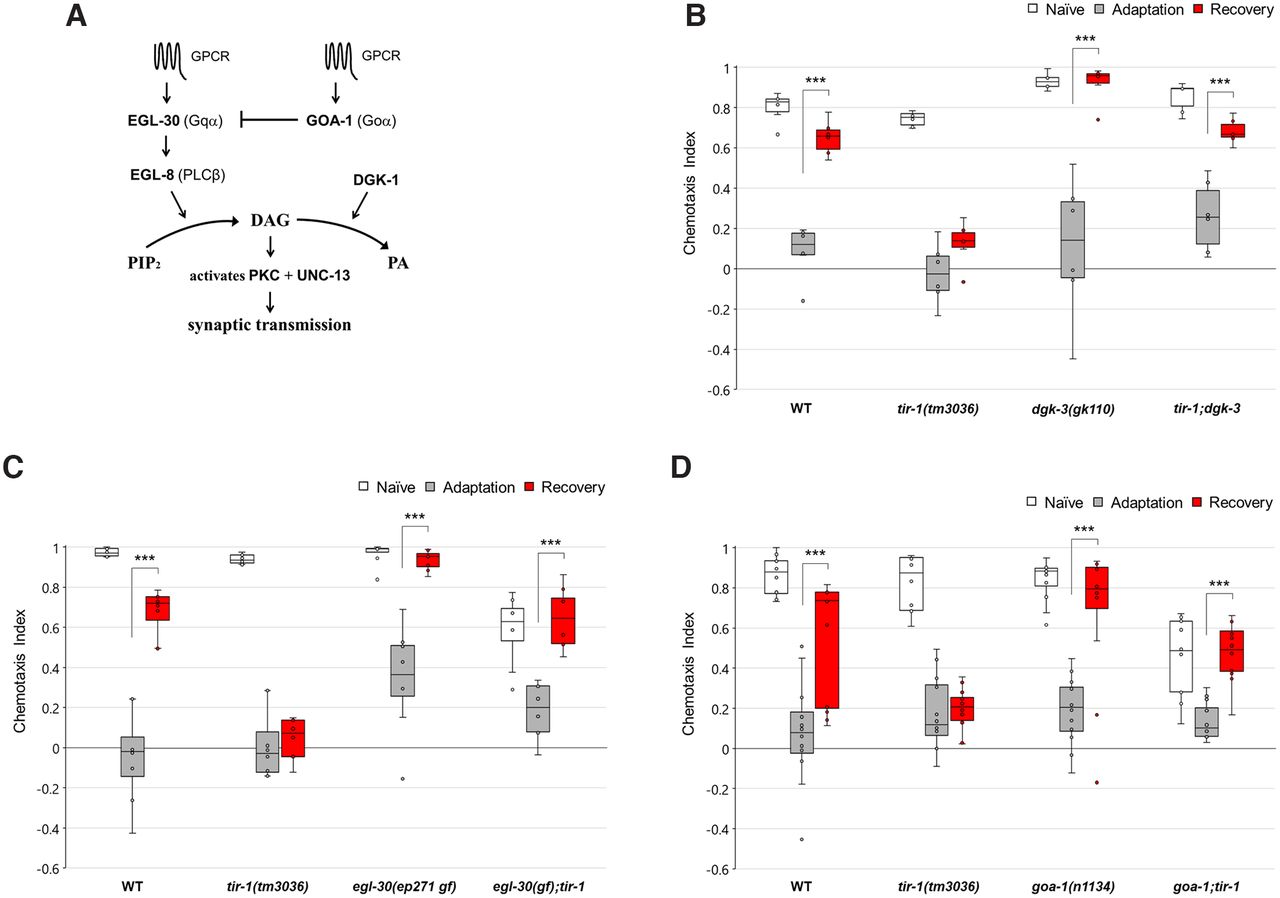
DGK-3, EGL-30 (Gαq), and GOA-1 (Gαo) are also involved in the regulation of forgetting downstream of the TIR-1/JNK-1 pathway. A, A model of the DAG signaling pathway based on Nurrish et al. (1999); Lackner et al. (1999); and Miller et al. (2000). DAG is produced by EGL-8 (PLCβ) downstream of EGL-30, which is inhibited by GOA-1, activates protein kinase C and UNC-13, and results in enhancing synaptic transmission. DGK-1 degrades DAG to PA. B, Suppression of the forgetting defect of the tir-1 mutant by the DAG kinase dgk-3. Chemotaxis of naive, adapted, and 4 h recovered animals was analyzed. Asterisks indicate significant differences between after adaptation and after 4 h recovery. WT: p = 8.87 × 10⁻⁹; dgk-3(gk110): p = 5.76 × 10⁻¹⁴; tir-1; dgk-3: p = 8.10 × 10⁻⁶ (n = 6, F(6,60) = 7.90, p = 2.73 × 10⁻⁶). C, Suppression of the forgetting defect of the tir-1 mutant by egl-30 gain-of-function mutation (ep271). WT: p = 2.51 × 10⁻¹⁵; egl-30(ep271 gf): p = 7.33 × 10⁻¹²; egl-30(gf);tir-1: p = 2.96 × 10⁻⁸ (n = 8, F(6,84) = 22.48, p = 1.25 × 10⁻¹⁵). D, Suppression of the forgetting defect of the tir-1 mutant by goa-1 loss-of-function mutation (n1134). WT: p = 5.77 × 10⁻⁸; goa-1: p = 1.87 × 10⁻⁸; goa-1;tir-1: p = 0.000104 (n = 12, F(6,132) = 8.50, p = 8.22 × 10⁻⁸). Box plots: center line indicates median. Box range, 25th-75th percentiles. Whiskers represent minimum-maximum values. Dots represent the data points. External dots from whisker represent outliers. ***p < 0.001 (two-way ANOVA with Bonferroni correction).


