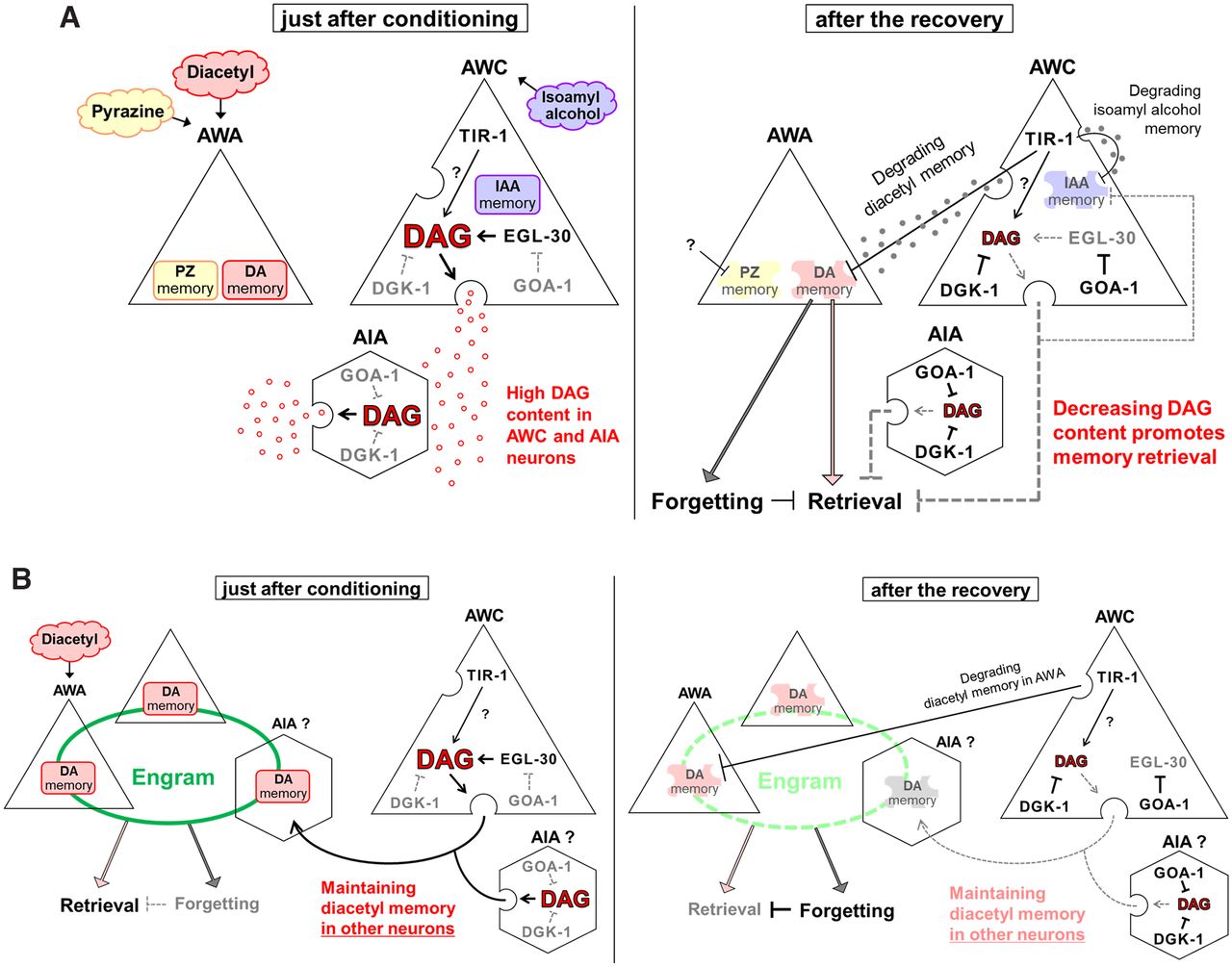
Proper DAG signaling is important for control of forgetting. Two schemes of potential hypotheses in this study. A, Regulation of the DAG content affects the determination whether to recall or to forget the memory of olfactory adaptation without affecting the sensory memory trace in AWA neuron. WT animals, in which DAG in AWC is properly regulated, can forget the memory depending on the sensory memory trace in AWA. On the other hand, tir-1 mutant, in which DAG in AWC is constantly lower than WT, cannot forget because of the remaining sensory memory trace in AWA. The goa-1;tir-1 mutant, in which the DAG signaling is facilitated, forgets because of a recall failure, although the sensory memory trace is intact. On the other hand, animals expressing goa-1(gf), in which the DAG signaling is inhibited in the AWC neuron, remember because of too intense recall, although the memory trace has been mostly eroded to the extent that the effect on the Ca2+ response cannot be observed. The TIR-1/JNK-1 pathway in the AWC neuron degrades the memory trace in the AWA neuron, independent of the DAG pathway. Additionally, forgetting of the memory of isoamyl alcohol that predominantly sensed by AWC neurons is regulated by TIR-1/JNK-1 pathway and, at least partially, by DAG signaling. On the other hand, pyrazine, although it is sensed by AWA neurons as well as diacetyl, its memory is not regulated by the TIR-1/JNK-1 pathway. B, The DAG signal may also maintain another memory trace stored in other neurons but not in the AWA neuron. A decrease in the DAG signal from the AWC neurons after memory acquisition would induce the degradation of the memory in neurons other than AWA; hence, the remaining memory in the engrams would become insufficient and unresponsive to retrieval. This causes animals to be able to forget, even in retaining a memory in AWA neurons. Additionally, because A and B possibilities are not mutually exclusive, the DAG signal can simultaneously regulate both pathways.


