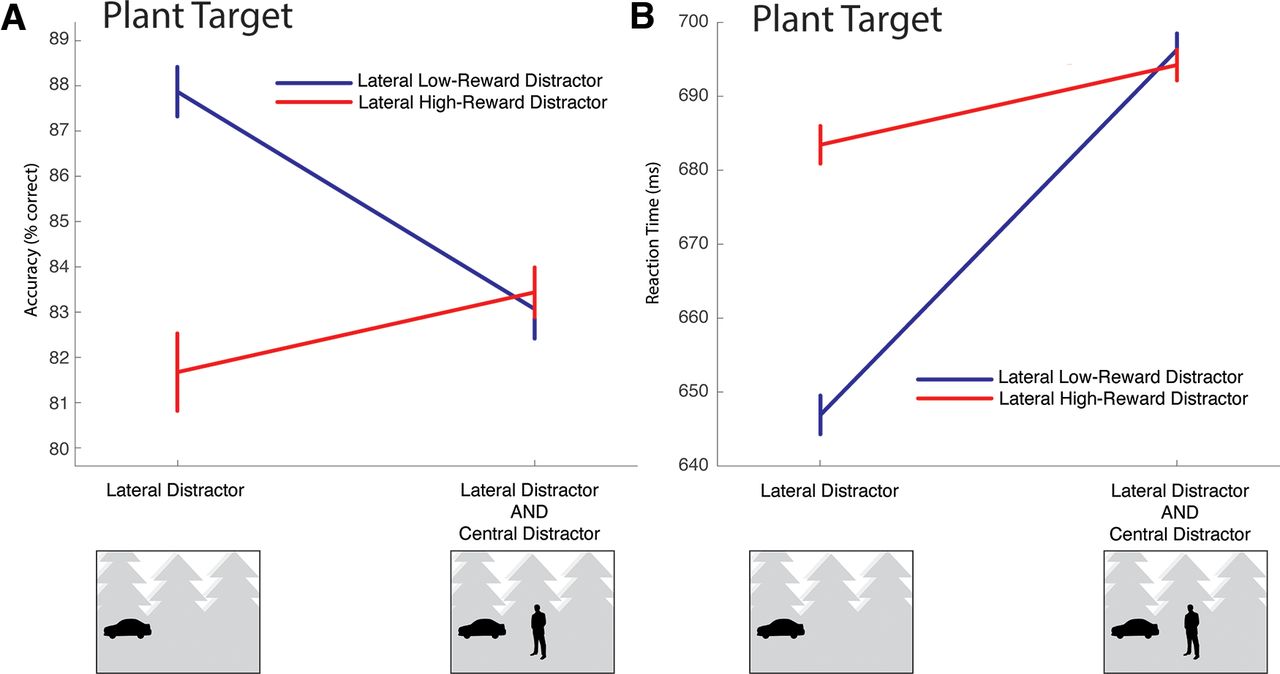
Results from conditions where participants searched for plants, which were used to test motivating experimental hypotheses regarding attentional capture. A, When participants searched for plants in scenes containing a single additional distractor, accuracy degraded when that distractor was associated with reward. However, when the scene contained both a lateral and a central distractor — and therefore always contained examples of both the high-reward and low-reward distractor categories — accuracy was insensitive to the specific locations of the two distractors. B, Similar results emerge in reaction times. When participants searched for plants in scenes containing a single additional distractor, reaction times increased when that distractor was associated with reward. However, when the scene contained two distractors, reaction time was insensitive to the specific location of these distractors.


