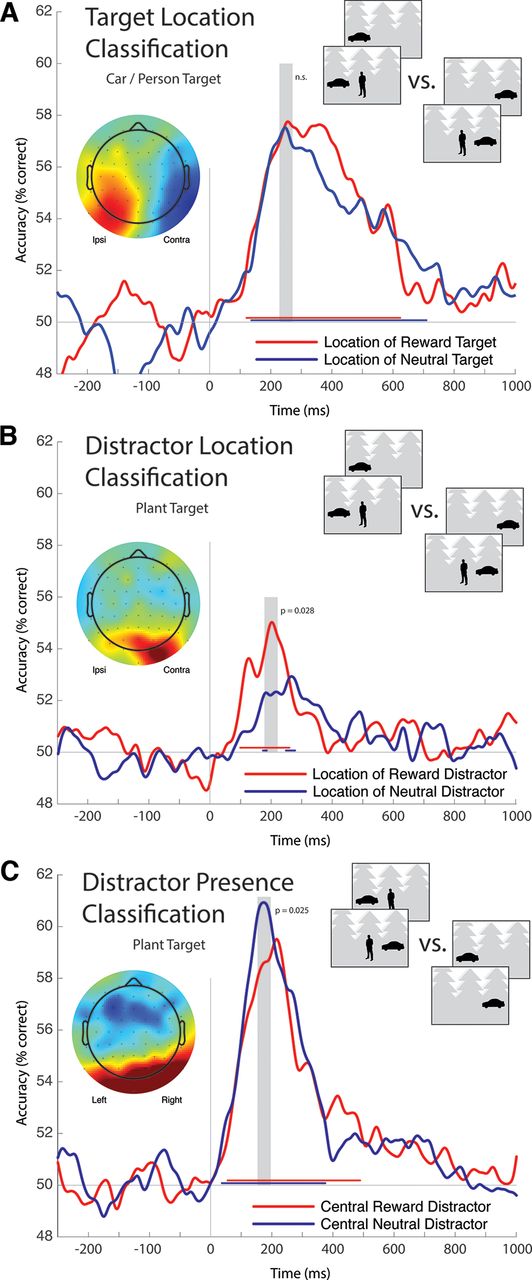
Results from trial-wise EEG classification. In all analyses, the machine learning algorithm is trained to discriminate between two classes of stimuli, and 50% accuracy reflects chance performance. Topographic maps reflect model decision criteria across reward conditions as measured over the latency intervals identified by gray shading in the corresponding time course plots, which is a 40 ms interval centered on peak decoding accuracy collapsed across conditions. Topographic plots are computed as the mean of spatially z-scored data for each individual and are therefore in SD units; while the topographical pattern is informative, the underlying values are uninformative and, as such, no scale is provided in the figure. Significant classifier accuracy in each condition is illustrated in the red or blue lines located just above the 50% baseline. A, Results from classification of target location. This analysis is intended to demonstrate the efficacy of the method, and to investigate the impact of reward association on target processing, but does not test the motivating experimental hypothesis regarding the capture of attention. Analysis does not identify a reliable difference in classification accuracy as a function of target reward association. B, Results from classification of distractor location. Location classification improves when the distractor is associated with reward. C, Results from classification of whether the distractor was present in the center of the scene. Presence classification degrades when the distractor is associated with reward.


