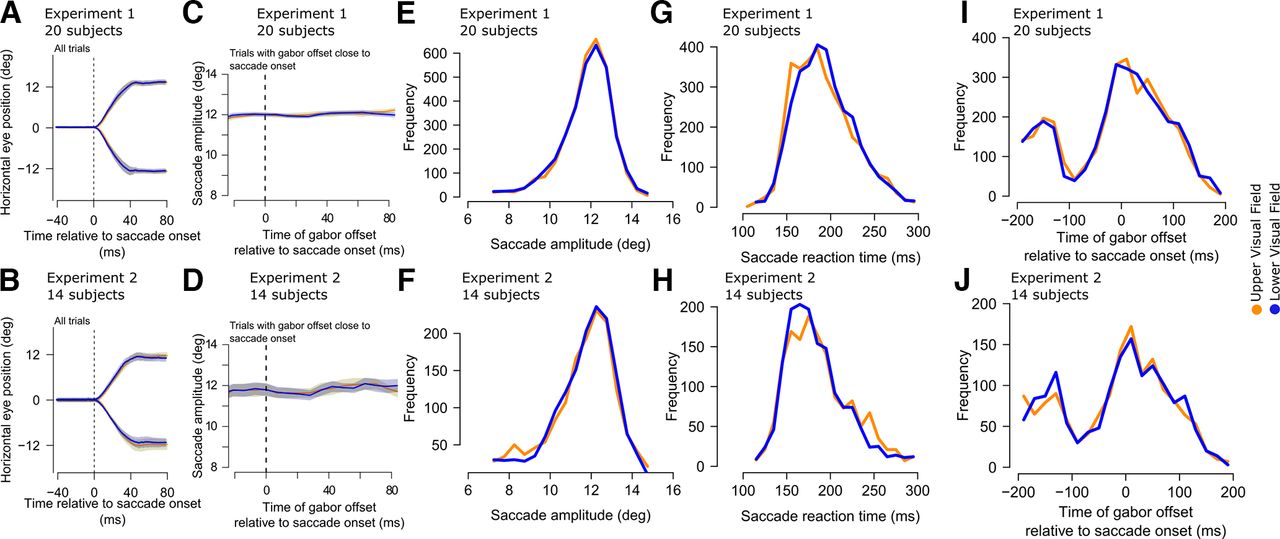
Similarity of eye movement metrics and timings between the upper and lower visual field target locations giving rise to differential peri-saccadic performance in Figure 1. A, B, Mean horizontal eye position traces for experiment 1 (A) and experiment 2 (B) separated by target location. Error bars denote two standard deviations. The saccades were similar whether the target appeared in the upper or lower visual field. C, D, Saccade amplitude separated by target location along the peri-saccadic interval during which we observed the strongest differences in performance between the upper and lower visual fields. There was no systematic difference between the saccades for the different target locations. Saccadic amplitude (E, F) and reaction time (G, H) in each experiment were also similar for upper or lower visual field targets. I, J, This implies that even the times of the gabor gratings relative to saccade onsets were matched between upper and lower visual field targets. Note that the dip in the histogram in each experiment is a known outcome of saccadic inhibition (Reingold and Stampe, 2002; Buonocore and McIntosh, 2008; Edelman and Xu, 2009; Bompas and Sumner, 2011), but it was, critically, no different between the two conditions. Thus, in all experiments, all eye movements were matched between upper and lower visual field target trials.


